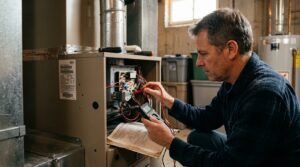
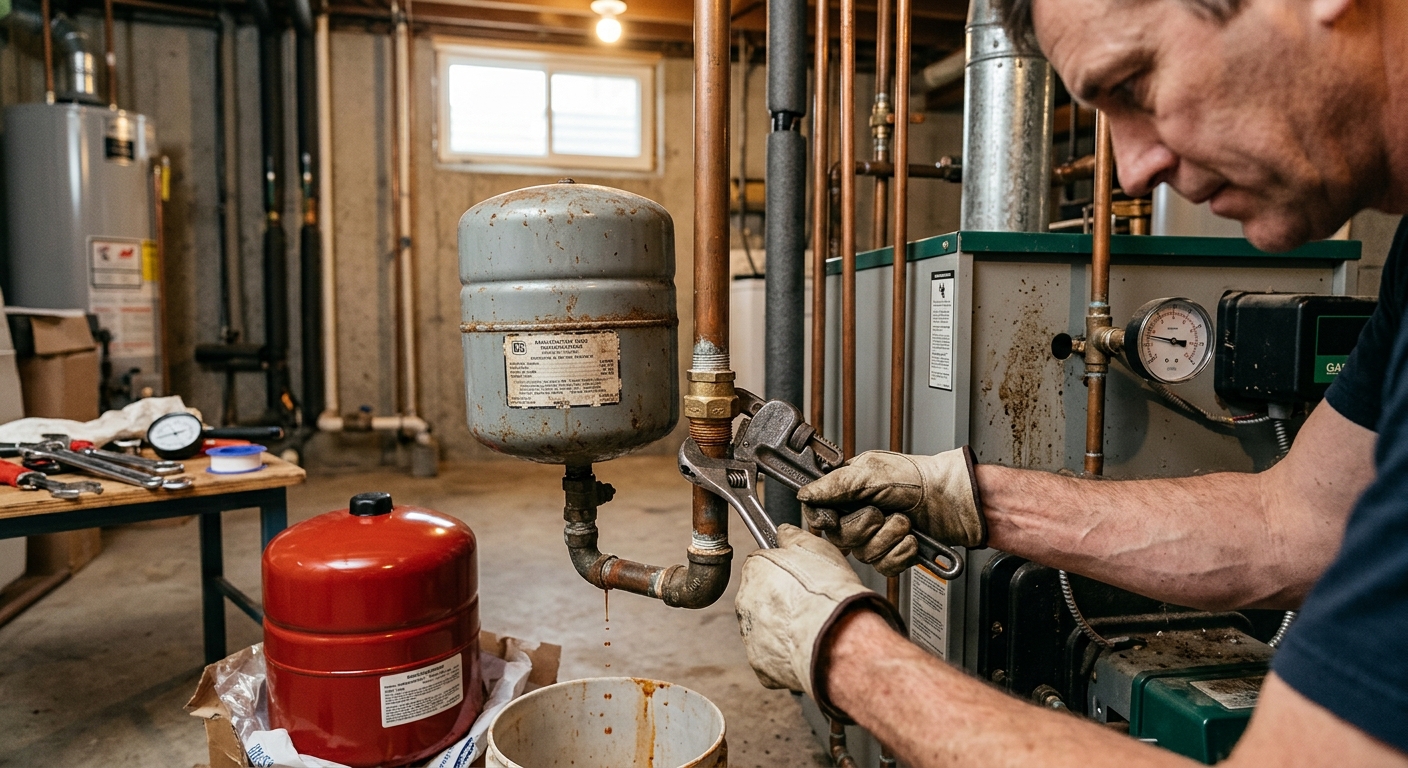
Tucked away near your water heater, the expansion tank is one of the most overlooked components in your home’s plumbing system. It is a small, football-shaped metal vessel that most homeowners never think about until something goes catastrophically wrong. Yet this humble device plays a critical role: it absorbs the extra water volume created when your water heater heats cold water, protecting your pipes, fixtures, and water heater from dangerous pressure spikes every single day.
Modern homes with a pressure-reducing valve (PRV) or backflow preventer operate as a closed plumbing system. That means when water expands during heating, there is nowhere for that excess pressure to go except into your pipes and fixtures. Without a functioning expansion tank, your system experiences what engineers call thermal expansion stress repeatedly, every time your water heater cycles. Over months and years, this degrades your water heater’s inner lining, wears out pressure relief valves prematurely, loosens pipe fittings, and shortens the life of every faucet and toilet fill valve in the house.
This post covers exactly what an expansion tank does, how to tell if yours has failed, and what you can do about it, from a quick pressure check you can do in 15 minutes to a straightforward DIY replacement. We will also cover when you need a licensed plumber and what it costs either way.
What You’ll Need
Click on an item below to shop for the recommended items for this recipe on Amazon.
As an Amazon Associate, we earn from qualifying purchases.
How to Do It
- Locate your expansion tank, it is typically a small gray or blue metal vessel connected to the cold water inlet pipe near the top of your water heater. It may be wall-mounted or hanging from the pipe.
- With the water heater running normally, tap the expansion tank firmly with your knuckles along its length. The bottom half should sound hollow (air-filled) and the top half should sound slightly different or solid. If the entire tank sounds hollow or the entire tank sounds solid like a water-filled drum, the internal bladder has likely failed.
- Use a tire pressure gauge on the Schrader valve at the top or end of the tank (it looks just like a bicycle tire valve). With all hot water fixtures closed, the reading should be within 2 psi of your home’s cold water supply pressure. A reading of 0 psi means the bladder has ruptured and the tank is waterlogged.
- Check your home’s incoming water pressure with a pressure gauge screwed onto a hose bib or laundry faucet. Normal range is 50 to 80 psi. If pressure reads above 80 psi, you also have a failing or missing pressure-reducing valve that needs attention.
- Inspect the tank body and connections for rust, corrosion, drips, or white mineral deposits that indicate a slow leak. Any of these signs means replacement is overdue.
- If the pre-charge reads 10 to 15 psi low but the bladder is intact, use a bicycle pump with a Schrader valve adapter to add air to match your supply pressure, then recheck after 30 minutes to confirm it holds.
- Purchase a replacement expansion tank sized for your water heater. A 2-gallon tank covers most 40 to 50 gallon water heaters; use a 4.5-gallon tank for 80-gallon units or if your supply pressure exceeds 70 psi. Amtrol Therm-X-Trol and Watts are two reliable brands available at home improvement stores for $50 to $100.
- Before removal, turn off the cold water supply to the water heater using the shutoff valve on the cold inlet line. Turn the water heater to pilot mode or the lowest setting. Open a hot water faucet nearby to relieve pressure in the line.
- Place a bucket under the expansion tank connection. Use an adjustable wrench to unscrew the old tank from its fitting. Have rags ready as residual water will drain out.
- Before installing the new tank, set its pre-charge pressure to match your home’s cold water supply pressure using a bicycle pump and pressure gauge. The factory pre-charge is typically 40 psi but your system may need 50 to 70 psi.
- Wrap the threaded inlet of the new tank with two to three layers of PTFE (Teflon) thread tape, then thread it onto the fitting by hand and tighten with a wrench. Do not overtighten; snug plus one quarter turn is sufficient for a watertight seal.
- Slowly reopen the cold water supply valve, then check all connections for drips. Restore the water heater to its normal operating temperature (120°F is the recommended safe setting). Run a hot water faucet until the system repressurizes, then recheck the T&P valve area for any signs of dripping, which would indicate it was already damaged and needs separate replacement.
- Call a licensed plumber and specifically request an expansion tank inspection and replacement. Ask whether a whole-system pressure check is included, as a good plumber will also verify your PRV setting and T&P valve condition during the same visit.
- Ask the plumber to document the installed tank size, pre-charge pressure set point, and incoming supply pressure reading in writing. This record is useful for insurance purposes and future maintenance.
- Request that the plumber check and, if needed, replace the T&P relief valve at the same time if it is over 5 years old or shows signs of mineral buildup. The valve itself costs $15 to $30 and adding it to an existing service call is far cheaper than a separate trip.
- If the plumber recommends a pressure-reducing valve adjustment or replacement, get that done in the same visit. A PRV replacement runs $200 to $400 but protects every fixture and appliance in your home from damaging high pressure.
Why It Works: The Benefits
A properly functioning expansion tank reduces daily pressure cycling stress, which can extend your water heater’s life by 3 to 5 years, delaying a $700 to $1,500 replacement.
Without pressure relief, a water heater’s T&P valve can fail open or the tank itself can rupture, releasing 40 to 80 gallons of hot water. The average water damage claim from a water heater failure runs $4,000 to $9,000 according to insurance industry data.
Chronic high pressure wears out toilet fill valves, faucet cartridges, and washing machine hoses faster. Keeping system pressure in the 50 to 80 psi range with a healthy expansion tank can cut fixture repairs by 30 to 50% over a decade.
Most jurisdictions adopted expansion tank requirements into plumbing code after 2002. A missing or failed expansion tank can void your homeowner’s insurance claim if a water heater failure occurs and the insurer determines deferred maintenance was the cause.
Eliminating the pressure spikes that cause water hammer reduces banging and knocking in your pipes, which is a concrete quality-of-life improvement that accompanies the safety gains.
💰 Savings Impact by Action
A functioning expansion tank reduces pressure fatigue on the water heater’s inner lining, extending its functional lifespan by up to 30% or 3 to 5 additional years.
Eliminating daily thermal expansion pressure spikes reduces T&P valve cycling by up to 80%, preventing premature failure of this critical safety device.
Maintaining system pressure below 80 psi reduces wear on faucet cartridges, toilet fill valves, and supply lines, cutting fixture repair frequency by roughly 35% over 10 years.
Proper thermal expansion management reduces the likelihood of a water heater pressure failure or T&P valve flood event by an estimated 60%, based on industry failure mode analysis.
🏠 Key Concepts Explained
The Science Behind It
Water is nearly incompressible, but it does expand in volume when heated. A 40-gallon tank of water heated from 50°F to 120°F gains roughly 0.8 gallons in volume, a 2% increase. In an open plumbing system (common in older homes), that extra volume simply pushes back against the municipal supply line. But any home with a pressure-reducing valve, check valve, or backflow preventer is a closed system, meaning that expanded water has no path of retreat. The pressure inside the system rises sharply, sometimes from a normal 60 psi to well over 150 psi during a heating cycle.
The expansion tank solves this with a simple and elegant mechanism. Inside the steel shell is a rubber bladder pre-charged with air. When system pressure rises during heating, water enters the tank and compresses the air bladder, absorbing the extra volume. When the water cools and contracts, the compressed air pushes the water back into the system, maintaining steady pressure throughout. The bladder acts as a hydraulic shock absorber, keeping pressure swings within a safe 50 to 80 psi range regardless of the heating cycle.
When the rubber bladder fails (typically from age, chloramine corrosion, or incorrect pre-charge pressure), the air charge is lost and the tank fills entirely with water. A waterlogged expansion tank cannot compress and offers zero buffering. The system reverts to raw thermal expansion pressure, and the T&P relief valve becomes the only pressure release in the system. Since that valve is rated for emergency use only, not daily cycling, it degrades rapidly. Building codes in most U.S. jurisdictions now require expansion tanks on all closed plumbing systems precisely because this failure cascade is predictable and preventable.
Frequently Asked Questions
▼ How do I know if my home even has a closed plumbing system that needs an expansion tank?
Look for a pressure-reducing valve (a bell-shaped brass fitting on the main water line where it enters your home) or a backflow preventer (a cylindrical device on the supply line). Either one creates a closed system requiring an expansion tank. If your home was built after 2002 or you are on municipal water in most U.S. cities, assume you have a closed system and need one.
▼ My expansion tank sounds completely hollow when I tap it. Is that bad?
A completely hollow sound throughout the entire tank usually means it has lost its water charge entirely, which can happen if the bladder has separated from the port. More commonly, a completely solid, water-filled sound indicates a waterlogged, failed tank. Ideally the tank should sound hollow at the air end and slightly muffled at the water inlet end. When in doubt, check the Schrader valve with a tire gauge: a reading of 0 psi confirms bladder failure.
▼ Can I just add air to my expansion tank instead of replacing it?
Yes, but only if the bladder is still intact. Check the Schrader valve with a tire gauge first. If you get a pressure reading greater than 0 psi, the bladder may simply be undercharged and you can add air with a bicycle pump to match your supply pressure. If the gauge reads 0 psi, or if water spits out of the Schrader valve, the bladder is ruptured and no amount of added air will fix it. Replace the tank.
▼ What size expansion tank do I need for my water heater?
For most standard 40 to 50 gallon water heaters with supply pressure between 40 and 60 psi, a 2-gallon expansion tank is sufficient. For 80-gallon heaters or supply pressures above 60 psi, use a 4.4 to 4.5 gallon tank. Oversizing does no harm and provides extra buffer, so if you are between sizes, go larger.
▼ My plumber says I do not need an expansion tank because my home is old. Is that right?
Older homes built before pressure-reducing valves became standard (generally pre-1980s) may have an open system where water can flow back into the street main, which does not require an expansion tank. However, if a PRV, check valve, or backflow preventer has been added at any point, the system is now closed and an expansion tank is required. Ask your plumber to verify whether a pressure-reducing valve is present before accepting that answer.
Quick Tips
- Check your expansion tank’s pre-charge pressure once a year using a simple tire gauge. It takes under two minutes and catches bladder failure before any damage occurs.
- If your T&P valve is dripping or you hear a faint hissing near the water heater, check the expansion tank first before replacing the T&P valve. A failed tank is the most common cause of T&P valve weeping.
- Expansion tanks have a typical lifespan of 5 to 10 years. If yours is approaching that age and has never been inspected, proactive replacement for $50 to $100 is far cheaper than waiting for a failure.
- If you are replacing a water heater, always replace the expansion tank at the same time. The labor is already paid for and the $60 to $80 part cost is trivial compared to the new heater investment.
Variations for Your Situation
- Apartment or Condo: Residents in multi-unit buildings typically cannot access the main plumbing riser or building-level expansion equipment. If you notice high water pressure, dripping fixtures, or a T&P valve weeping in a unit with its own water heater (common in condos), contact your building maintenance or HOA immediately and document the request in writing. You are not responsible for the fix but you are responsible for reporting it to protect your unit from water damage.
- Tight Budget (under $50): The cheapest meaningful action is a full inspection using only a $10 tire gauge and a $10 hose-bib pressure gauge. Confirming whether your expansion tank is functional and your supply pressure is within the 50 to 80 psi range costs almost nothing and tells you whether you have an urgent problem. If the tank fails inspection, a basic 2-gallon expansion tank runs $45 to $65 at home improvement stores and is a straightforward swap requiring only basic tools.
- Older Home (pre-1980): Homes of this era often lack a pressure-reducing valve entirely, which means the system may still be open and an expansion tank is not required. However, many older homes have had PRVs added during renovations without a corresponding expansion tank installation. Prioritize measuring your supply pressure first. If it reads above 80 psi, a PRV is needed regardless of expansion tank status. Also inspect older galvanized or copper supply lines near the water heater for corrosion, since high-pressure cycling accelerates joint failures in aged piping.