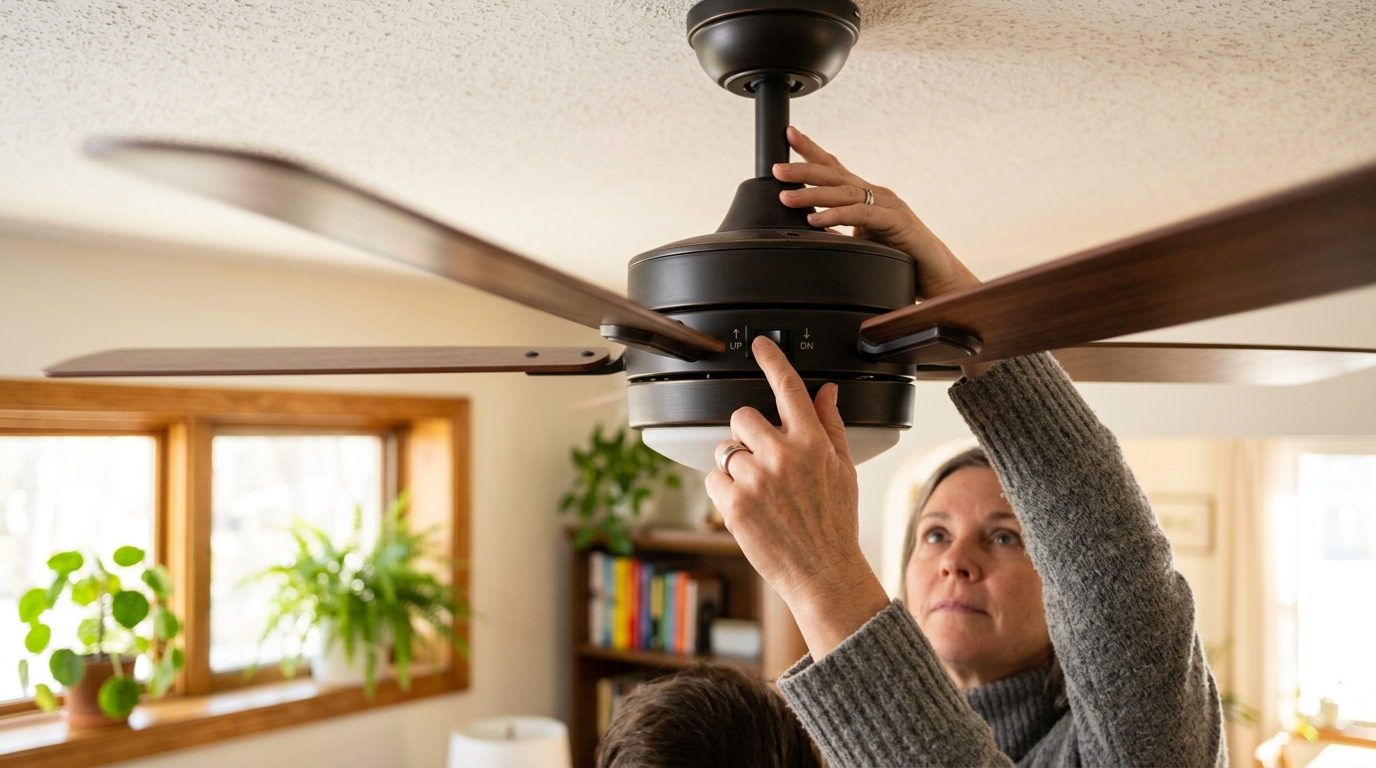
Here is a surprising fact: roughly half of all ceiling fans in American homes are spinning in the wrong direction right now. That single oversight turns a comfort tool into a comfort killer, pushing warm air down in winter when you want it circulated gently, and failing to create the wind-chill effect in summer that lets you raise your thermostat by 4 degrees Fahrenheit without feeling warmer. The result is higher energy bills and a room that never quite feels right no matter how long the fan runs.
Ceiling fans do not actually cool air. They cool people by accelerating evaporation of moisture from skin, a phenomenon called the wind-chill effect. That distinction matters enormously, because it means a fan running in the wrong direction in summer is just stirring hot air around your head with no benefit, while your AC works overtime. In winter, the wrong direction can even increase drafts and make occupants feel colder, causing them to crank up the heat.
This post covers exactly why fan direction matters, how to identify and fix it in under a minute, and how to pair the change with a thermostat adjustment that delivers real, measurable savings on your utility bills every single month.
What You’ll Need
Click on an item below to shop for the recommended items for this recipe on Amazon.
As an Amazon Associate, we earn from qualifying purchases.
How to Do It
- Turn the fan off completely and wait for the blades to stop spinning. Never reach for the motor housing while the fan is moving.
- Look for a small slide switch on the side of the motor housing, the cylindrical center section just below where the fan mounts to the ceiling. It is typically labeled with arrows or the words Forward and Reverse.
- For summer, slide the switch so the fan spins counterclockwise when viewed from below. Stand under the fan and look up: blades should move left across the top of their arc.
- For winter, slide the switch to the clockwise position. Viewed from below, blades move right across the top of their arc.
- Turn the fan back on. In summer, use high speed. In winter, use the lowest speed setting to avoid a draft effect.
- Adjust your thermostat up 4°F in summer to capture the full energy savings the fan makes possible.
- Turn off the fan circuit at your breaker panel and verify power is off at the fan using a non-contact voltage tester before touching any wiring.
- Remove the fan canopy cover at the ceiling mount to expose the wiring. Most canopies are held by two screws.
- Install a compatible remote receiver module (brands like Hampton Bay or Hunter make universal options for $25 to $50) by connecting it inline with your existing fan wiring according to the included instructions. Tuck the receiver into the canopy.
- For a smart fan, replace the wall switch with a smart fan speed controller such as a Lutron Caseta Fan Speed Control ($45 to $80). These allow direction and speed changes from an app or voice assistant.
- Restore power, pair the remote or app, and test both direction settings from ground level.
- Set a recurring calendar reminder for the first day of November and the first day of April to switch fan direction seasonally, so you never forget again.
Why It Works: The Benefits
Running a correctly directed fan in summer lets you set your thermostat 4°F higher, cutting air conditioning energy use by 8 to 10% according to the U.S. Department of Energy, while maintaining the same perceived comfort level.
Reversing to clockwise rotation in winter redistributes warm air pooled at the ceiling, reducing heating demand by up to 15% in rooms with high ceilings, according to ENERGY STAR data.
The wind-chill effect from a correctly directed fan makes a 78°F room feel like 72 to 74°F, eliminating that sticky, stagnant sensation without any additional equipment.
When your thermostat setpoint is 4°F higher in summer, your AC compressor runs fewer cycles per day, reducing mechanical wear and potentially extending system life by one to two years.
Fixing fan direction costs nothing. Most fans have a physical direction switch on the motor housing, and some newer models can be reversed from a remote or app in under 10 seconds.
💰 Savings Impact by Action
Correcting to summer counterclockwise rotation and raising the thermostat 4°F reduces AC energy use by 8 to 10% per the U.S. Department of Energy.
Clockwise low-speed rotation redistributes stratified ceiling heat and can reduce heating energy consumption by up to 15% in rooms with ceilings above 8 feet.
Eliminating fan runtime in unoccupied rooms eliminates 15 to 75 watts of continuous draw, saving 5% or more on total fan electricity cost annually.
Each 1°F increase in summer thermostat setpoint saves 2 to 3% on cooling costs, so a 4°F setback enabled by proper fan use saves roughly 8 to 10% per cooling season.
🏠 Key Concepts Explained
The Science Behind It
A ceiling fan’s ability to make you feel cooler comes entirely from convective heat transfer and evaporative cooling, not from any change in air temperature. When air moves across your skin at even 1 to 2 miles per hour, it carries heat and moisture away faster than still air can. The result is a perceived temperature drop of 4 to 8°F even though a thermometer in the room would show no change whatsoever. This is the same principle that makes a 50°F windy day feel colder than a 40°F calm day.
Blade direction controls which way air is pushed. Fan blades are manufactured with a fixed pitch, typically 12 to 15 degrees. When the motor spins counterclockwise (summer mode), the leading edge of each blade scoops air and drives it straight down toward the floor, creating the column of moving air you feel as a breeze. Reverse the motor to clockwise (winter mode) and that same pitched blade now acts like an airplane wing in reverse, pulling air up from the room center and pushing it outward along the ceiling, then down the walls. This circulation pattern mixes the warm stratified air near the ceiling with the cooler air below without directing airflow onto seated or standing occupants.
Thermal stratification is the reason winter reversal matters so much in rooms with tall ceilings. Physics dictates that warmer, less dense air rises and cooler, denser air sinks. In an 8-foot ceiling room, the temperature differential between floor and ceiling is relatively small, but in a vaulted or cathedral ceiling room of 12 to 16 feet, that gap can exceed 10°F. Your furnace is working hard to heat air that is pooling uselessly at the roofline. A clockwise ceiling fan at low speed breaks up that stratification layer, pushing the warm air down where occupants actually are, and your thermostat registers the room as warmer sooner, causing the furnace to cycle off earlier and burn less fuel.
Frequently Asked Questions
▼ I flipped the switch to counterclockwise but I still cannot feel any breeze. What is wrong?
First confirm the fan is actually spinning counterclockwise by standing directly below and looking up. If blades move left at the top of the arc, the direction is correct. The issue may be fan speed: make sure you are running it on high in summer. If the fan is on high, moving the right direction, and you still feel nothing, the blade pitch may be too shallow or the blades may be installed upside down, which occasionally happens after cleaning or reinstallation. Check that the angled edge of each blade faces upward from center to tip.
▼ My ceiling fan does not have a direction switch anywhere on it. Can I still reverse it?
Some older or lower-cost fans are wired for a single direction and lack a physical reverse switch. Check if your fan came with a remote, since many remotes include a reverse function that overrides the motor direction electronically. If there is no remote and no switch, you can install a compatible aftermarket remote receiver for $25 to $50, or it may be time to replace the fan with a modern reversible model, which typically costs $60 to $200 and pays back quickly through the efficiency gains.
▼ How long before I see the savings show up on my electric bill?
You will feel the comfort difference immediately, but bill savings depend on your billing cycle and how consistently you apply the thermostat setback. If you raise your thermostat 4°F the same day you fix the fan direction, expect to see a 6 to 10% reduction on your next monthly cooling bill. Most homeowners notice the difference within one full billing cycle, typically 30 days.
▼ Should I run my ceiling fan at the same time as my central air conditioning?
Yes, and this is one of the most effective combinations for efficiency. Run the fan in summer mode and raise the thermostat 4°F. The fan costs pennies per hour to run, while the 4-degree setback saves 8 to 10% on your AC bill. The net result is meaningful savings with no reduction in perceived comfort. Just remember to turn the fan off when you leave the room.
▼ My fan wobbles and shakes. Is it safe to keep running it while I fix the direction?
A wobbling fan should be addressed before continuing to operate it. Minor wobble (less than a quarter inch of movement) is often caused by a blade that is slightly out of balance and can be fixed with a blade balancing kit (under $10 at any hardware store). Significant wobble or a fan that shakes the entire light fixture suggests a loose mounting bracket or an overloaded junction box, both of which are safety hazards requiring an electrician to inspect before further use.
Quick Tips
- Label the two switch positions on your fan motor housing with a small piece of tape marked S (summer) and W (winter) so you never have to guess again.
- Turn fans off when you leave a room. A fan left running in an empty room provides zero comfort benefit and consumes 15 to 75 watts continuously.
- In summer, pair your fan with blackout curtains on west-facing windows. Blocking afternoon sun reduces solar heat gain by up to 77%, making your fan far more effective at maintaining comfort.
- In rooms with both a ceiling fan and a window AC unit, run the fan to circulate cool air more evenly throughout the space, which lets the AC cycle off sooner and reduces runtime by 10 to 15%.
Variations for Your Situation
- Apartment/Rental: Most rental units have existing ceiling fans that tenants can use without any modification. Simply flip the direction switch on the motor housing yourself since this requires no tools and leaves no mark. If your unit lacks ceiling fans, ask your landlord about installation since landlords often agree when framed as a cooling cost reducer. Alternatively, a tower fan or pedestal fan aimed across your body provides the same wind-chill effect and is fully portable when you move.
- Tight Budget (under $50): The direction fix itself is completely free and delivers the largest share of the savings. Pair it with a $10 roll of reflective window film on your sunniest windows and a $7 programmable outlet timer to automatically cut fan power when you typically leave for work. These three changes together can reduce summer cooling costs by 12 to 15% with under $20 invested.
- Older Home (pre-1980): Homes built before 1980 often have ceiling fans wired to a single-pole switch with no neutral wire at the switch box, which limits smart switch compatibility. Stick with the physical direction switch on the motor housing and a standard remote receiver rather than a smart controller. Also inspect the junction box the fan mounts to since older boxes rated for light fixtures only are not rated for fan weight and movement, and a fan-rated metal box (about $10 to $15) may need to be installed before safe operation.