Recessed lighting looks sleek and modern, but each can light punched through your ceiling is essentially a hole in your thermal envelope. Standard recessed fixtures can leak as much conditioned air as leaving a window cracked open year-round. In a home with 20 recessed lights, that heat loss adds up fast, and it shows up directly on your energy bill every single month.
The bigger danger is how most homeowners try to fix it. Piling insulation directly on top of a standard recessed can creates a serious fire risk. Most older fixtures are rated IC-N, meaning they are not insulated-contact rated and require 3 inches of clearance from all insulation. Covering them traps heat from the bulb, and that heat has nowhere to go. The National Fire Protection Association links improperly insulated recessed fixtures to hundreds of house fires each year.
This post walks you through the two safest and most effective approaches: installing airtight fireproof covers over your existing cans, or replacing the fixtures entirely with IC-rated airtight (ICAT) units. Both approaches eliminate air leakage, remove the fire risk, and can cut ceiling-related heat loss by 15 to 25 percent. Whether you are a careful DIYer or ready to call an electrician, there is a right answer here for your situation.
What You’ll Need
Click on an item below to shop for the recommended items for this recipe on Amazon.
As an Amazon Associate, we earn from qualifying purchases.
How to Do It
- Access your attic during daylight or with a headlamp. Locate each recessed fixture from above, which will appear as a metal can protruding up through the ceiling drywall.
- Check the fixture label inside the can from below. Look for the letters IC or IC-N. If you see any label warning about minimum clearance from insulation, this approach is especially important for your home.
- Move any existing insulation away from the fixture so you have a clear 12-inch working radius around each can.
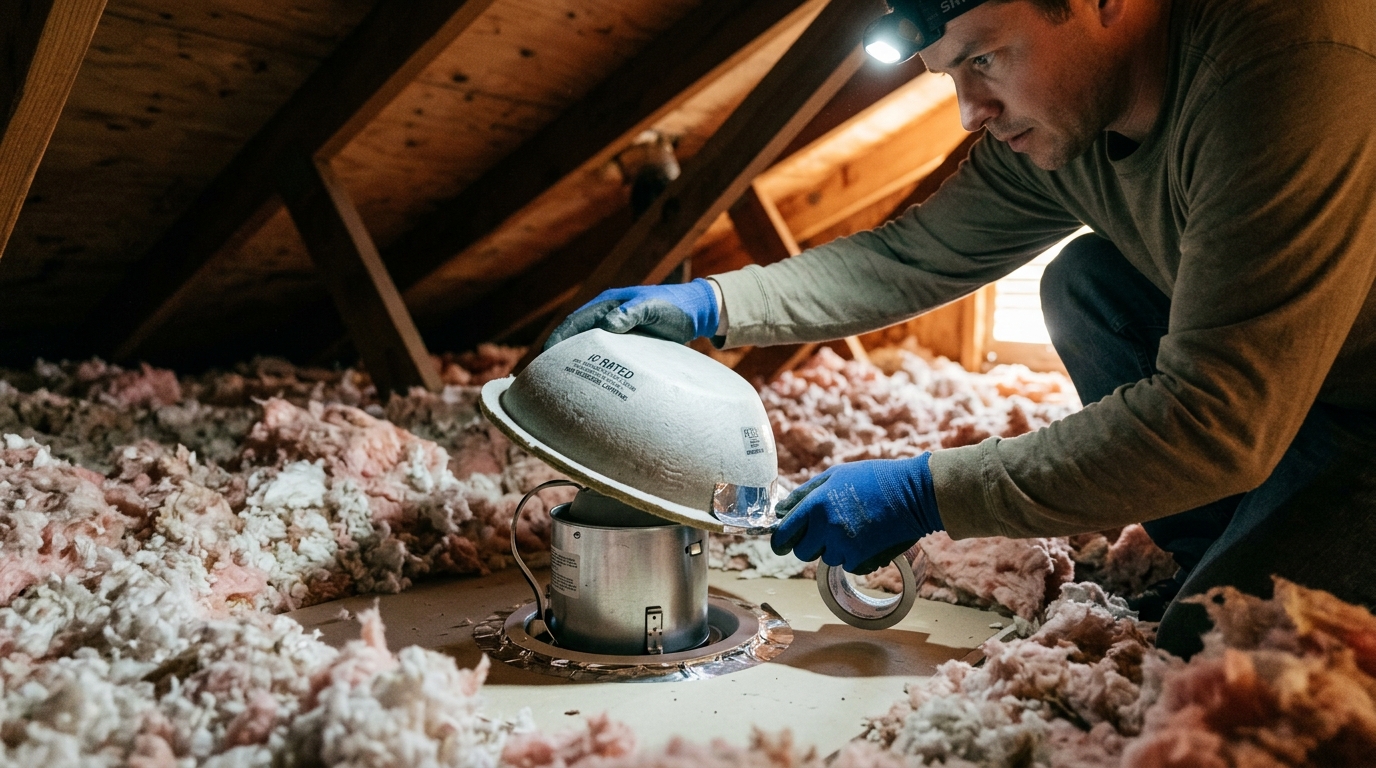
- Place the airtight fire-rated cover dome over the recessed can. The dome should fully cover the fixture and sit flat on the ceiling drywall with no gaps at the base.
- Apply a continuous bead of fire-rated acoustical sealant or non-expanding foam around the entire perimeter where the dome meets the drywall. Do not use standard expanding foam as it can crack and lose its seal.
- Push insulation back around and over the dome. You can now safely pile insulation on top of the cover because the dome is rated for insulation contact and provides the required air gap around the actual fixture.
- Hire a licensed electrician to assess your existing fixtures and confirm whether your wiring gauge and circuit capacity are compatible with modern ICAT housings.
- Choose ICAT fixtures rated for your ceiling type, specifically airtight models with an Energy Star certification label. Popular and well-regarded options include the Halo H99ICAT and Lithonia Lighting ICAT series.
- The electrician will remove each existing housing from the attic side by disconnecting the junction box, pulling the old housing free, and installing the new ICAT unit into the same rough opening.
- The new ICAT housing is secured to the joists and all wiring is reconnected inside the factory-sealed junction box. No drywall repair is needed in most cases since the trim ring covers the same opening.
- After installation, apply a bead of paintable acoustical caulk around the trim ring from inside the room to seal the gap between the trim and the drywall for maximum air tightness.
- Blow or lay new insulation directly over the new ICAT fixtures. Because these are IC-rated by design, no clearance is required and you can bring insulation up to the target R-value without restriction.
Why It Works: The Benefits
Properly sealing and insulating around recessed lights reduces ceiling air leakage by up to 70 percent per fixture, translating to 15 to 25 percent lower heating and cooling costs in homes where recessed lighting is widespread.
Using airtight covers rated for insulation contact or replacing with ICAT-rated fixtures brings the installation into full code compliance and removes the sustained heat buildup that causes recessed light fires.
Sealing ceiling air leaks reduces cold drafts in winter and hot spots in summer, making rooms with recessed lighting noticeably more comfortable without changing the thermostat setting.
Stopping warm humid air from escaping into the attic through fixture gaps cuts condensation on attic framing, reducing the risk of mold and rot that can cost thousands of dollars to remediate.
Many utility companies offer rebates of $50 to $200 for air sealing projects that include recessed light treatment. Check DSIRE.org or your utility’s website to see if your upgrade qualifies.
💰 Savings Impact by Action
Sealing recessed fixture gaps with airtight covers reduces ceiling air leakage by up to 70 percent per fixture, cutting total home heating and cooling loss by 15 to 22 percent in heavily recessed homes.
Replacing IC-N fixtures with ICAT units limits leakage to 2 CFM per fixture compared to 50 to 100 CFM for unblocked cans, reducing ceiling heat loss by up to 25 percent.
Switching from incandescent or halogen bulbs to LED retrofits in recessed cans reduces lighting energy consumption by 75 percent and lowers fixture heat output, extending housing life.
Once recessed lights are properly sealed, adding blown-in insulation to bring the attic to R-49 reduces whole-ceiling heat transfer by an additional 15 percent compared to R-19 or lower.
🏠 Key Concepts Explained
The Science Behind It
A typical unblocked recessed light can behaves like a small chimney. Interior air, which is warmer and more buoyant than attic air in winter, is constantly pushed up through the fixture by the stack effect. Research from Lawrence Berkeley National Laboratory found that a single unsealed recessed fixture can leak between 50 and 100 cubic feet of conditioned air per hour. In a home with 15 fixtures, that is equivalent to leaving a window fully open around the clock.
The reason sealing is more important than insulating here comes down to the difference between conduction and convection. Insulation batts and blown-in cellulose are excellent at slowing conductive heat transfer through solid materials, but they do almost nothing to stop air movement. When air flows freely through a gap, it carries heat with it at a rate roughly 40 times faster than conduction through the same space. This is why two inches of fiberglass batt draped over a leaking can light does essentially nothing to reduce heat loss at that location.
Fire risk is also rooted in basic thermodynamics. An incandescent or halogen bulb converts only 5 to 10 percent of its energy into visible light, releasing the remaining 90 percent as heat directly into the fixture housing. Standard IC-N housings are engineered to dissipate that heat safely into the surrounding air. When insulation blocks that airflow, the fixture temperature climbs well above its design limit. Over months of normal use, this repeated thermal stress dries out nearby wood fibers and reduces their ignition temperature, sometimes to the point where they can ignite without an open flame, a phenomenon fire investigators call pyrolysis.
Frequently Asked Questions
▼ How do I know if my recessed lights are IC-rated or not?
Turn off the circuit, remove the bulb and trim ring, and look for a label stamped or printed on the inside of the metal housing. An IC-rated fixture will clearly say IC or Type IC on the label. If you see IC-N, Non-IC, or any language specifying minimum clearance from insulation, the fixture is not rated for insulation contact. If there is no label at all, treat it as IC-N to be safe and use a cover dome or replace the fixture.
▼ Can I just use regular spray foam to seal around my recessed lights?
Standard expanding spray foam is not appropriate for use directly against or inside recessed fixture housings because it can degrade under the heat cycles, crack over time, and may not meet local fire code requirements for insulation contact with electrical fixtures. Use fire-rated acoustical sealant or intumescent foam rated for use around electrical penetrations instead. These products maintain their seal and will not create a compliance issue if your home is inspected.
▼ My attic is really cramped and I cannot move around easily. Is there a way to do this from inside the room?
Yes, but with limitations. You can apply paintable acoustical caulk around the trim ring on the room-side of the fixture to reduce interior air leakage. However, this addresses only a fraction of the total leakage and does nothing about insulation clearance in the attic. If attic access is genuinely unsafe, the professional ICAT replacement approach is the better path because the electrician can typically install the new airtight housing from the attic side during the fixture swap.
▼ Will sealing my recessed lights cause them to overheat and burn out faster?
Not if you follow the correct approach. The airtight cover dome method preserves the required air gap around the fixture inside the dome, so the housing still dissipates heat normally even though insulation can now be placed on the exterior of the dome. ICAT replacement fixtures are specifically engineered to run within safe temperatures under full insulation contact. Switching from incandescent or halogen bulbs to LEDs at the same time significantly reduces heat output and extends bulb life.
▼ How long until I actually see savings on my energy bill?
Most homeowners notice a reduction in drafts and a modest bill drop within the first full heating or cooling season after sealing. The DOE estimates that comprehensive air sealing of ceiling penetrations, including recessed lights, typically reduces annual energy costs by 10 to 20 percent. Given a cover-dome project cost of $150 to $300 for an average home, payback usually falls between 1 and 3 years depending on your climate and energy rates.
Quick Tips
- Photograph the label inside each recessed can before going into the attic so you know exactly what you are working with before you start buying materials.
- If your fixtures still use incandescent or halogen bulbs, switch to LED retrofits at the same time. LEDs generate a fraction of the heat, reducing thermal stress on the fixture and cutting lighting energy use by 75 percent.
- Use a can of pre-mixed fire-rated acoustical sealant rather than foam, as it stays flexible and does not crack when the fixture heats and cools with normal use.
- Mark each fixture location in the attic with a small flag or colored tape before you start so you do not miss any cans once insulation is disturbed.
- If you are adding blown-in insulation to the attic at the same time, complete all recessed light sealing first. It is nearly impossible to find and seal fixtures once insulation covers them.
Variations for Your Situation
- Apartment or Condo: Renters and condo owners rarely have attic access and cannot modify fixtures without landlord permission. Focus on the interior-side seal by applying a thin bead of removable paintable acoustical caulk around the trim ring where it meets the drywall. This alone can reduce per-fixture leakage by 20 to 30 percent at a cost of under $10 for the entire home. Document what you do and inform your landlord, as it is a non-damaging improvement.
- Tight Budget (under $50): Skip the professional replacement entirely and buy airtight cover domes at roughly $8 to $12 each. Prioritize the fixtures in the rooms where you spend the most time and where drafts are most noticeable. Even sealing just 5 fixtures in a main living area will deliver meaningful comfort and energy improvements. A single tube of fire-rated acoustical sealant costs under $10 and is sufficient for 8 to 10 covers.
- Older Home (pre-1980): Homes built before 1980 almost certainly have IC-N fixtures and may also have aluminum wiring, which requires special connectors and a licensed electrician for any fixture work. Do not attempt fixture replacement yourself. The cover dome approach is safe and effective without touching the wiring. Also check that your attic insulation is not vermiculite, which may contain asbestos and requires professional testing before any disturbance.