A zoned HVAC system is one of the smartest investments a homeowner can make. Instead of heating or cooling your entire house to one temperature, zoning lets you direct conditioned air only where it’s needed, cutting energy waste and keeping every room comfortable. On paper, the savings can reach 20 to 30% on annual heating and cooling costs. In practice, many homeowners with zoned systems see little to none of that benefit because the system has drifted out of calibration, was never set up correctly, or has a mechanical problem that quietly undermines everything.
The frustrating part is that a misbehaving zone system rarely fails dramatically. The AC still runs. The heat still comes on. But one zone is always too hot, another is always cold, the equipment short-cycles, or the energy bills creep up despite the promise of savings. Because the symptoms look like ordinary HVAC complaints, homeowners often blame the equipment rather than the zoning controls, dampers, or bypass configuration.
This post breaks down the six most common reasons zone systems underperform, gives you two clear paths to diagnose and fix the problem yourself, and explains when it’s time to bring in a professional. Whether your system has two zones or six, you’ll come away knowing exactly what to check first and what realistic improvements look like in real numbers.
What You’ll Need
Click on an item below to shop for the recommended items for this recipe on Amazon.
As an Amazon Associate, we earn from qualifying purchases.
How to Do It
- Map your zones: Write down which thermostats control which rooms. At each thermostat, call for heating or cooling and then walk to every supply register in that zone to confirm dampers are opening. Hold a tissue near each register to feel for airflow. A zone with no airflow when calling points to a failed damper or wiring issue.
- Check thermostat placement: Confirm each zone thermostat is on an interior wall, away from supply registers, windows, lamps, and exterior doors. A thermostat within 3 feet of a supply register or in direct afternoon sun will misread zone temperature by 3 to 5 degrees. Relocating or shielding the thermostat is a free fix with immediate results.
- Review temperature schedules: Log into each smart thermostat or check programmed schedules. Overlapping or conflicting schedules across zones force the system to satisfy opposing calls simultaneously, causing the zone controller to prioritize incorrectly and leave some areas unserved. Stagger zone setbacks by 30 minutes to prevent simultaneous demand.
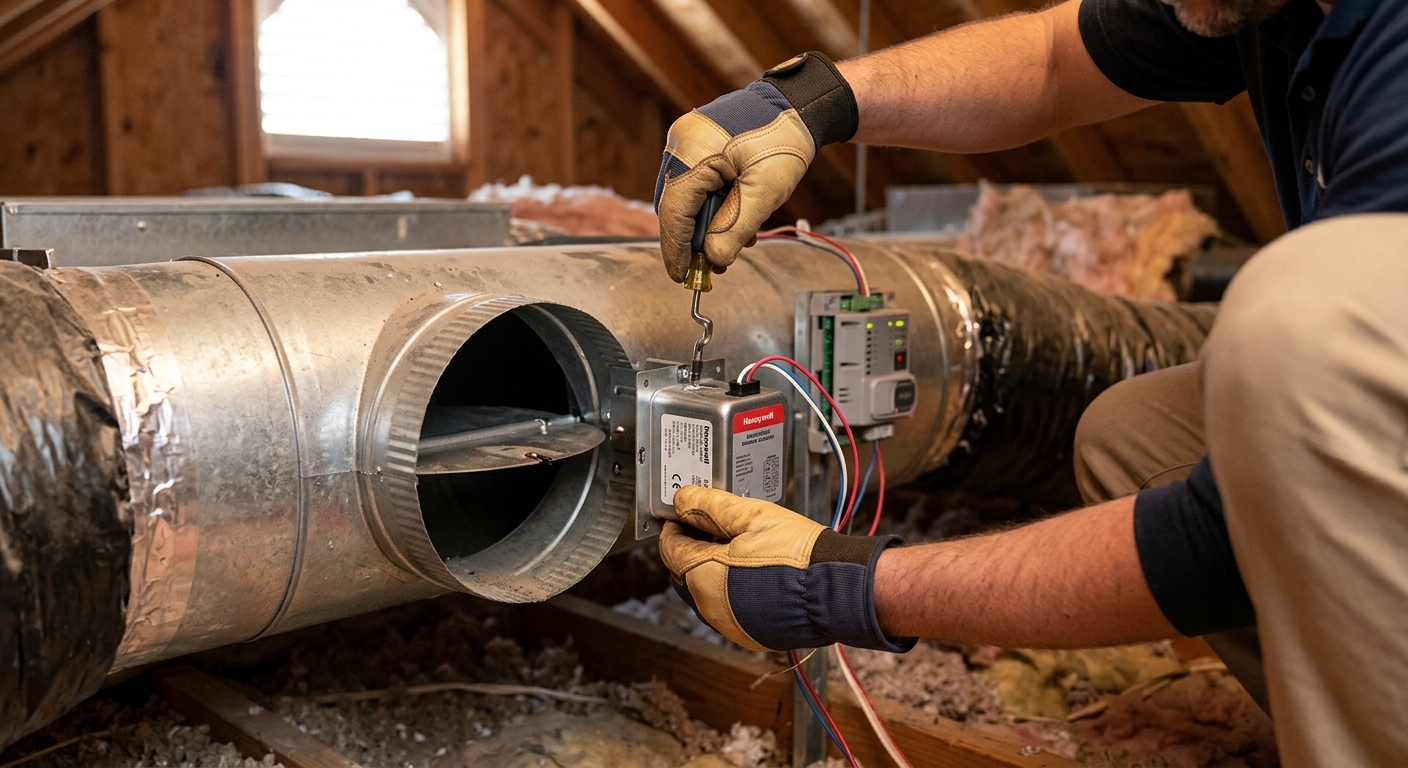
- Inspect the bypass damper: Locate the bypass damper (usually a round damper on the supply plenum or a duct running from supply back to return). With only one small zone calling, stand near the bypass and feel for airflow. If you feel strong airflow through the bypass with all zones open, the damper is stuck open and should be adjusted or replaced. Bypass dampers cost $40 to $80 to replace yourself.
- Check zone controller indicator lights: Most zone control boards have LED indicators for each zone and for system calls. Consult your board’s manual (available online by model number) and confirm each zone LED responds correctly when that thermostat calls. A zone that never lights up on the board has a wiring or thermostat issue, not a duct problem.
- Measure airflow at registers: Use an inexpensive anemometer ($20 to $40) to measure air velocity at each supply register in every zone while that zone is calling. Compare readings across registers in the same zone. Registers delivering less than half the airflow of others in the same zone indicate a partially closed or failed damper on that branch.
- Manually test each damper actuator: At each zone damper, disconnect the actuator wiring harness (with system power off) and apply 24 volts AC from a spare transformer or a 24V thermostat wire to the open and close terminals. The damper blade should move smoothly to fully open and fully closed positions. A damper that sticks, moves slowly, or does not move needs the actuator replaced. Replacement actuators for common brands like Honeywell or Aprilaire run $30 to $80.
- Seal damper actuator penetrations: With the dampers accessible, apply foil-faced HVAC tape around the actuator shaft penetrations where they pass through the duct wall. This simple step eliminates actuator-seal leakage that allows 5 to 15% of airflow to bypass a closed damper.
- Adjust or replace the bypass damper: If your bypass damper is manual (a hand-adjustable blade), set it so it opens only when static pressure builds in the supply plenum. A good rule of thumb is to adjust it until you feel moderate resistance when the largest zone is closed and a single small zone is calling. If the bypass is a pressure-activated automatic damper, confirm it opens at 0.5 to 0.8 inches of water column by holding a manometer to the supply plenum access port. Replace the bypass if it fails to open in that range.
- Re-calibrate zone thermostat offsets: Most smart thermostats allow a temperature offset adjustment of plus or minus 3 to 5 degrees in settings. Use a calibrated standalone thermometer to measure actual room temperature, then adjust each thermostat’s offset to match. This corrects sensing errors without moving the thermostat and typically takes 5 minutes per zone.
- Document and retest: After completing adjustments, run each zone individually for a full heating or cooling cycle (at least 15 minutes) and confirm airflow, temperature delivery, and damper behavior. Note any zones that still underperform for follow-up with a professional if needed.
- Schedule an HVAC technician experienced specifically with zoning systems (ask before booking, as not all residential techs work with zone controllers regularly). Request a full system commissioning, not just a standard tune-up.
- Have the technician perform a static pressure test across all zone configurations: all zones open, one zone open, and each zone individually. Results should be logged and compared to the equipment manufacturer’s airflow specifications.
- Request damper actuator testing on every zone, including confirmation that each damper achieves a true closed position. Leaky dampers should be replaced during this visit.
- Ask for zone controller firmware update or board replacement if the board is more than 10 years old or shows erratic relay behavior. Modern zone controllers from brands like Honeywell TrueZONE or EWC Controls include priority zone logic that older boards lack, improving comfort noticeably.
- Have the technician verify refrigerant charge and evaporator airflow after zone work is complete, since static pressure changes from zone corrections affect coil performance and may require minor airflow adjustments at the air handler.
Why It Works: The Benefits
A properly functioning zone system delivers 20 to 30% savings on heating and cooling versus a single-zone setup. If your system has been underperforming, correcting bypass damper calibration and thermostat placement alone can recover 10 to 15% of that lost savings within the first billing cycle.
Fixing zone damper sequencing and thermostat sensing errors eliminates the chronic hot and cold spots that make zoning frustrating. Properly balanced zones maintain temperatures within 1 to 2 degrees of setpoint rather than swinging 4 to 6 degrees as the system hunts.
Reducing static pressure overload and eliminating short-cycling can extend compressor and blower motor life by 3 to 5 years. Compressor replacements average $1,500 to $2,500, so proper zone calibration is meaningful preventive maintenance.
Short-cycling caused by zone imbalance is one of the leading causes of high indoor humidity in summer. When the system runs full cycles, the evaporator coil has time to condense and drain moisture properly, keeping relative humidity in the comfortable and healthy 40 to 50% range.
High static pressure from misconfigured zones stresses duct seams, damper actuators, and the blower motor. Homeowners who correct zone problems early report avoiding $300 to $800 in duct repair and actuator replacement costs over a 5-year period.
💰 Savings Impact by Action
Correcting a stuck or miscalibrated bypass damper restores proper airflow and eliminates compressor short-cycling, recovering up to 15% in wasted operating costs.
Fixing a 3 to 5 degree thermostat sensing error through offset calibration or relocation reduces over-conditioning of satisfied zones by 10 to 12% annually.
Sealing actuator penetrations and blade leaks on closed dampers eliminates 5 to 15% conditioned air bleed into unoccupied zones, reducing wasted conditioning.
Properly staggered zone setback schedules that avoid simultaneous zone conflicts can reduce total HVAC runtime by up to 18% compared to identical setpoints across all zones.
Reducing static pressure from 0.8 to 0.5 inches of water column by correcting bypass sizing restores blower airflow efficiency and cuts blower motor energy use by up to 10%.
🏠 Key Concepts Explained
The Science Behind It
A central HVAC system is engineered to move a specific volume of air, measured in cubic feet per minute (CFM), against a specific resistance, measured in inches of water column of static pressure. When zone dampers close off portions of the duct system, the total resistance increases. The blower, designed for a specific fan curve, moves less air as resistance rises. Less airflow across the evaporator coil means the refrigerant absorbs heat more slowly, extends run time, and in extreme cases causes the coil to ice over. The bypass damper exists specifically to maintain minimum airflow by creating an alternate low-resistance path back to the return, keeping the blower operating near its design point regardless of how many zones are active.
Thermostat accuracy matters more in a zoned system than in a single-zone setup because each thermostat is the sole feedback signal for its zone. In a conventional system, a thermostat 3 degrees off from actual room temperature is a minor annoyance. In a zoned system, that same error tells the zone controller the zone is satisfied when it is not, closing the damper and locking out that zone while other zones are served. The result is a chronic comfort failure that owners blame on duct design when the real cause is a $15 thermometer calibration error. Correcting thermostat offset through software or physical relocation costs nothing but dramatically improves zone accuracy.
Short-cycling is the hidden energy penalty of a poorly configured zone system. A properly sized HVAC system in a well-zoned house should run cycles of 10 to 20 minutes to maintain setpoint. When a zone is too small relative to the equipment capacity, or when a bypass damper continuously recirculates supply air back to the return without properly conditioning the zone, the thermostat satisfies in 3 to 5 minutes. Short cycles do not allow the evaporator coil to drop to its design temperature of 35 to 45 degrees Fahrenheit, so moisture that condenses on the coil re-evaporates back into the airstream instead of draining away. The result is high indoor humidity, reduced comfort, and energy bills that climb even as the system appears to be cycling off frequently.
Frequently Asked Questions
▼ One zone never reaches its setpoint temperature no matter how long the system runs. What’s wrong?
The most common causes are a stuck-closed damper in that zone’s branch duct, a failed actuator that stopped opening, or a wiring break between the zone controller and that damper. Start by manually commanding the zone to call for full heating or cooling, then physically go to each supply register in that zone and feel for airflow. If registers are dead, pull the actuator connector and test it with 24 volts as described in the DIY approach. Actuator replacement costs $30 to $80 and resolves this issue in about 80% of cases.
▼ My HVAC short-cycles constantly when only one small zone is calling. How do I stop it?
Short-cycling with a single small zone active is a classic bypass damper problem. The small zone satisfies the thermostat quickly while excess supply air recirculates through the bypass rather than conditioning the space. First, confirm your bypass damper is opening by holding your hand near it during a single-zone call. If airflow is strong, the damper is working but the zone is genuinely too small for the equipment output, meaning you may need a variable-speed air handler or to combine adjacent zones. If no airflow comes through the bypass with a small zone active, the bypass damper is stuck closed and needs adjustment or replacement.
▼ My energy bills went up after a zone system was installed. Shouldn’t it save money?
A poorly commissioned zone system can actually increase energy use compared to a standard single-zone setup. The most common culprits are high static pressure from closed dampers forcing the blower to consume more electricity, a bypass damper recirculating supply air without conditioning the intended zones, and thermostats with temperature sensing errors causing the system to over-run. Start with the quick diagnostic walkthrough in this post, paying particular attention to bypass damper airflow and thermostat placement. If the system was installed within the last two years, contact the installer and request a commissioning verification, as most HVAC contractors warranty their work.
▼ Can I add more zones to my existing zone system myself?
Adding zones is not a DIY project in most cases. Each new zone requires a new damper installed in the ductwork, a new thermostat with wiring run back to the zone controller, and reconfiguration of the zone controller board. More critically, adding zones changes the static pressure profile of the entire system and typically requires recalculating bypass damper sizing. Doing this incorrectly can damage your compressor or blower motor. Get quotes from two or three HVAC contractors with zoning experience. Adding one zone to an existing 2-zone system typically costs $400 to $900 installed.
▼ My zone dampers are making a loud buzzing or clicking noise. Is that a problem?
Yes, and you should not ignore it. A buzzing actuator is usually drawing power but failing to move the damper blade, either because the blade is stuck against debris or the actuator motor is failing. A clicking noise at startup often indicates a relay problem on the zone controller board. Either condition leads to a zone that does not open or close correctly, creating the comfort and efficiency problems described throughout this post. A technician can replace a single actuator for $100 to $200 including labor, or replace the zone controller board for $200 to $450 depending on the brand.
Quick Tips
- Label every zone damper at the duct with a marker or tape tag showing which zone it serves. This makes future diagnostics 10 times faster and is almost never done at installation.
- Set unoccupied zones to a setback temperature of 4 to 6 degrees above or below your occupied setpoint rather than turning them off entirely. Fully shutting off a zone for long periods increases temperature differential and forces the system to work harder when the zone is reactivated.
- If your zone controller is more than 12 years old, check whether a firmware update is available from the manufacturer. Several common boards had logic bugs in early versions that caused improper damper sequencing, and updated firmware is free.
- Replace cheap round manual bypass dampers with a pressure-sensing automatic bypass damper if your system has more than three zones. Automatic bypass units ($80 to $150) maintain consistent static pressure without manual adjustment as your household’s zone usage patterns change seasonally.
Variations for Your Situation
- Apartment or Condo with Fan Coil Zones: Many high-rise apartments use individual fan coil units rather than central ducted zoning. If your unit has fan coils, zone performance problems usually trace to dirty coil fins (clean annually with coil cleaner spray, $12 to $18), a stuck zone valve on the chilled or hot water line, or a failed fan speed controller. These are accessible behind access panels and can be inspected without landlord permission in most cases. Report stuck zone valves to building management since they involve the central hydronic system.
- Tight Budget (under $50): Focus first on thermostat calibration and schedule corrections, which cost nothing. Buy a calibrated digital thermometer ($8 to $15) to check each zone thermostat’s accuracy and use the offset adjustment in thermostat settings to correct any error. Next, buy foil HVAC tape ($10 to $15) and seal around every damper actuator penetration you can reach. These two steps alone can recover 8 to 12% of lost zone efficiency without touching any mechanical components.
- Older Home with Original Zone System (pre-2005): Zone control boards and actuators from the early 2000s and older are significantly more prone to relay failures and damper calibration drift. If your board is from this era, budget for replacement during your next diagnostic. Modern boards from Honeywell, EWC, or Carrier run $150 to $300 and include improved priority zone logic. Also have a technician check that your bypass damper sizing still matches your current equipment, as many homeowners have replaced HVAC units without updating the bypass, creating a persistent static pressure mismatch.