If you’ve watched your exterior paint bubble, crack, and peel just a year or two after a fresh coat, you’re not alone. Millions of homeowners repaint their homes every three to five years when a properly prepped paint job should last ten to fifteen years. The culprit is almost never the paint itself. It’s what happened, or didn’t happen, before the first brush stroke.
Peeling exterior paint is more than an eyesore. Bare wood absorbs moisture, which leads to rot, mold, and structural damage that can cost thousands to repair. A solid paint film is your home’s first line of defense against the elements, and it only holds if the surface beneath it is clean, dry, and properly primed. Skipping or rushing prep work is the single most common reason paint jobs fail early.
In this post, we’ll cover the building science behind why paint peels, the most common causes on typical homes, and two approaches to fixing it, from a targeted quick fix for small problem areas to a full DIY prep and repaint that will actually last. Whether you’re dealing with a few blistered boards or widespread peeling across an entire facade, you’ll know exactly what to do and why it works.
What You’ll Need
Click on an item below to shop for the recommended items for this recipe on Amazon.
As an Amazon Associate, we earn from qualifying purchases.
How to Do It
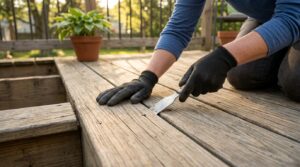
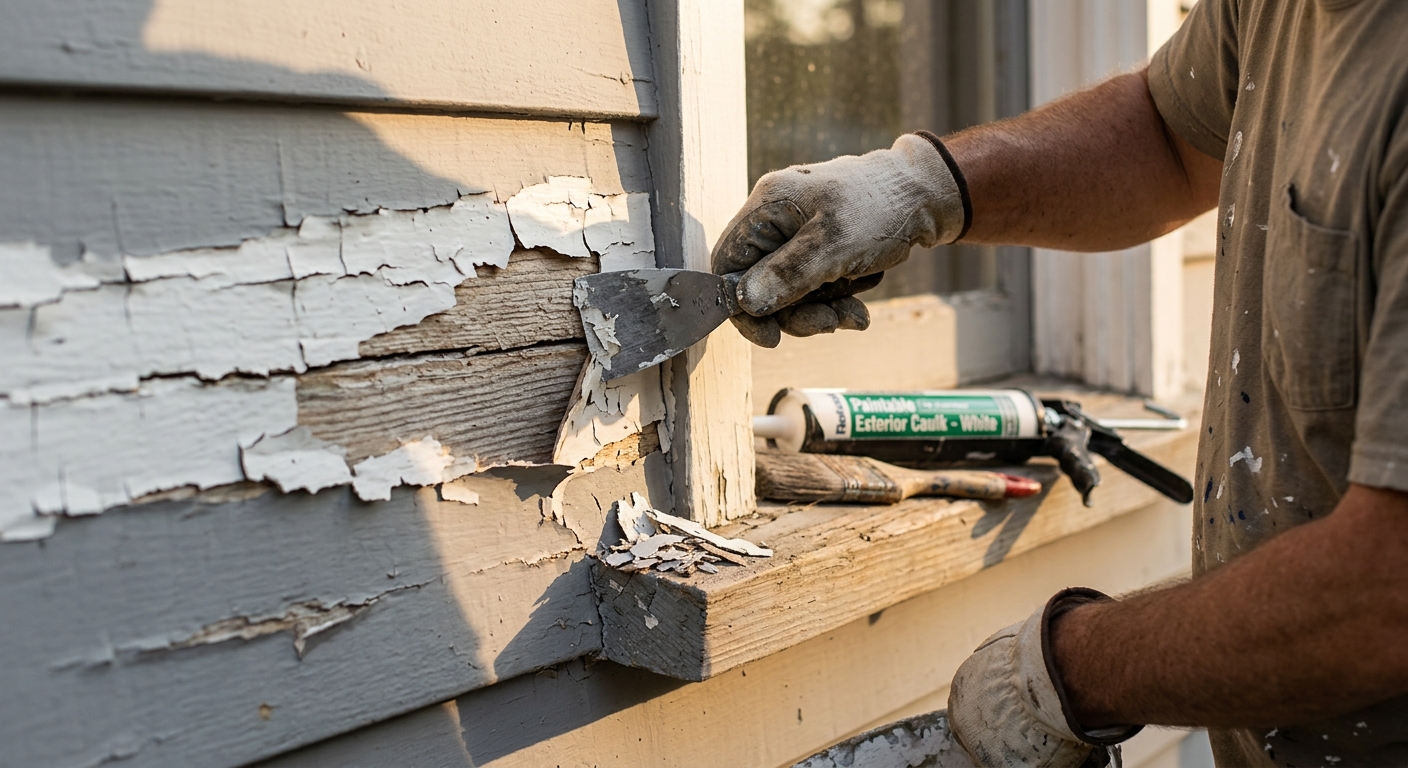
- Scrape all loose and peeling paint from the affected area using a stiff-bristle paint scraper or 5-in-1 tool. Feather the edges so there is no sharp ridge where old paint meets bare wood.
- Sand the scraped area with 80-grit sandpaper to smooth rough spots, then follow with 120-grit to blend the transition. Wipe away all dust with a damp cloth and let the surface dry completely, at least 24 hours.
- Check for moisture with a pin-type moisture meter. The reading must be at or below 15 percent before you apply any product. If it reads higher, allow more drying time or address the moisture source first.
- Apply a coat of exterior oil-based or shellac-based spot primer to bare wood areas only. These penetrating primers seal end grain and bare wood far better than latex primer for small repairs. Let it dry per label directions.
- Apply one to two coats of a matching exterior latex topcoat, feathering each coat slightly beyond the primed area to blend with the existing paint. Allow full dry time between coats, typically 4 to 6 hours.
- Inspect the entire exterior for rotted wood, failed caulk, and missing or damaged flashing before you do anything else. Repair or replace rotted boards, recaulk all seams between trim and siding with paintable exterior caulk, and correct any drainage or flashing issues that could reintroduce moisture after painting.
- Power wash the entire surface using a pressure washer set to 1,500 to 2,000 PSI with a 25-degree fan tip. Mix a solution of 1 cup trisodium phosphate (TSP) or a TSP substitute with 1 quart of oxygen bleach per gallon of water to kill mildew and remove chalk. Work top to bottom and rinse thoroughly.
- Allow the siding to dry for a minimum of 48 to 72 hours after washing. Verify dryness with a pin-type moisture meter at multiple locations. Do not proceed until readings are consistently at or below 15 percent moisture content.
- Scrape all remaining loose paint with a long-handled scraper. Sand all scraped areas starting with 80-grit paper and finishing with 120-grit. Lightly sand all glossy surfaces that will be painted to give the primer mechanical adhesion. Remove all dust by brushing and wiping.
- Apply a full coat of exterior acrylic bonding primer to all bare wood and sanded areas. On highly porous or weathered wood, apply a second coat. Allow the primer to cure fully per the manufacturer’s instructions, typically 24 hours, before topcoating.
- Apply two coats of a high-quality 100-percent acrylic exterior paint rated for your climate. Use a brush for trim and cut-in work, a roller for flat siding sections, and an airless sprayer if you have experience with one. Back-brush sprayed areas to work paint into surface texture. Allow 4 to 6 hours between coats and do not paint in direct sun or when temperatures are below 50 degrees Fahrenheit or above 90 degrees Fahrenheit.
Why It Works: The Benefits
A properly prepped and primed paint job on clean, dry wood lasts 10 to 15 years. Skipping prep typically yields 2 to 5 years before failure, meaning proper prep can eliminate two to four full repaints over the life of the house.
Bare or poorly protected wood absorbs moisture and begins to rot within one to three seasons. Repairing rotted siding or trim boards costs $500 to $3,000 per section; a full siding replacement can run $8,000 to $20,000 or more on a typical home.
Fresh, well-adhered exterior paint is one of the highest-return cosmetic improvements a homeowner can make, with real estate agents consistently citing it as a top factor in first impressions and listing price.
Properly cleaned surfaces treated with a mildewcide wash before painting and finished with a mildew-resistant exterior paint dramatically reduce the biological growth that discolors and degrades paint films, especially on shaded north-facing walls.
A sound paint film helps protect insulation and sheathing from moisture infiltration, preserving the thermal performance of your wall assembly. Wet insulation loses up to 40 percent of its R-value, making paint integrity a genuine energy efficiency concern.
💰 Savings Impact by Action
Proper prep extends paint life from 3 to 5 years to 10 to 15 years, reducing repainting frequency by 60 percent over a 15-year period.
A continuous, well-adhered paint film prevents moisture from reaching bare wood, eliminating up to 90 percent of the rot risk that leads to costly siding repairs.
Preventing moisture intrusion through the wall assembly preserves insulation R-value, since wet fiberglass or cellulose can lose up to 40 percent of its thermal resistance.
Cleaning with a bleach-TSP solution before painting and using a mildew-resistant topcoat reduces biological regrowth by up to 75 percent compared to painting over untreated surfaces.
🏠 Key Concepts Explained
The Science Behind It
Paint adhesion is fundamentally a chemistry and physics problem. For paint to bond to wood, the liquid paint film must wet out the surface, meaning it must flow into and fill the microscopic texture of the substrate. Contamination from dirt, chalk, mildew, or oil raises the surface energy of the wood in a way that causes paint to bead rather than spread, resulting in poor mechanical and chemical bonding. This is why cleaning is not optional; it is the foundation of everything that follows.
The relationship between wood and moisture is the other critical variable. Wood is hygroscopic, meaning it continuously absorbs and releases water vapor depending on ambient humidity. When liquid water or vapor is trapped beneath a paint film, it exerts vapor pressure as temperatures rise. That pressure has to go somewhere, and the weakest point is the paint-to-wood interface. The result is the familiar blister and peel pattern that appears most dramatically on south and west-facing walls where sun-driven vapor pressure is highest. The fix is not a better topcoat; it is eliminating the moisture source and sealing the wood with a penetrating primer before vapor can enter.
Primer works by penetrating the wood fibers and polymerizing into a matrix that locks to the substrate mechanically and chemically. It also provides a uniform surface energy for the topcoat to bond to. Oil-based and shellac-based primers penetrate more deeply than latex primers, making them the superior choice for bare or weathered wood even if you plan to topcoat with latex. The topcoat’s job is UV resistance, color retention, and water shedding. The primer’s job is adhesion. Skipping primer and applying two topcoats instead does not give you two layers of adhesion; it gives you zero, because topcoat paint is formulated to bond to primer, not to bare or weathered wood.
Frequently Asked Questions
▼ My paint is peeling from the inside out, not the top surface. What causes this?
This is a classic sign of vapor drive from inside the wall. Warm, humid interior air pushes through the wall and condenses on the cold sheathing or siding, saturating the wood from behind. The fix involves improving interior ventilation, adding bathroom and kitchen exhaust fans, and in some cases installing a vapor retarder on the interior side of exterior walls. Back-priming the siding on the inner face before repainting helps slow vapor entry from that direction.
▼ I just repainted last year and it is already peeling. Do I need to strip it all the way down?
Probably yes, at least in the affected areas. If paint failed after one season, the surface was either wet, contaminated, or not primed adequately at the time of application. Applying another coat over failing paint will fail in the same way. Scrape to bare wood, check moisture content with a meter, prime with an oil-based or shellac-based primer, and repaint. Cutting corners again will produce the same result.
▼ How do I know if I have lead paint before I start scraping?
Pick up an EPA-approved lead test swab kit at any hardware store for about $8 to $15. Swipe the swab across a scraped edge that exposes multiple layers of paint. A color change to red or pink indicates the presence of lead. If the result is positive, stop scraping and either hire an EPA-certified RRP contractor or follow full containment procedures using a lead-rated P100 respirator, plastic sheeting to contain dust, and proper disposal of debris.
▼ Can I paint over existing paint that is still firmly adhered, or do I have to remove it all?
Firmly adhered existing paint in good condition can be topcoated without full removal, but you must clean it thoroughly, sand glossy surfaces to dull the sheen, and use a bonding primer before the new topcoat. The tape test is your guide: press a strip of painter’s tape firmly to the surface and pull it off quickly. If paint comes with it, the existing coating is not adequately bonded and must be removed before repainting.
▼ What temperature should I avoid painting in, and does it matter for prep steps too?
Apply paint only when air and surface temperatures are between 50 and 90 degrees Fahrenheit and humidity is below 85 percent. Temperatures outside this range prevent proper film formation and adhesion. Prep steps like scraping, sanding, and washing are less temperature-sensitive, but the wood surface must not be frozen, and washing should be done when temperatures will stay above 40 degrees overnight to allow proper drying before you prime.
Quick Tips
- Paint in the shade whenever possible. Direct sunlight causes the paint surface to skin over before solvents escape from below, trapping bubbles and reducing adhesion.
- Buy one premium-quality paint rather than two coats of a budget product. High-quality 100-percent acrylic paints contain more binders and pigment, which directly translates to longer service life.
- Caulk after priming but before topcoating. Primer seals the wood around the joint, and caulk bonds best to primed surfaces. Caulking bare wood or over the topcoat are both inferior approaches.
- Keep a paint log with the date, product names, and batch numbers. When you touch up in three years, matching the sheen and formula is much easier with this reference.
Variations for Your Situation
- Apartment or Condo Owner: If you own a condo or are responsible for your unit’s exterior under a maintenance agreement, confirm with your HOA or property manager before starting any paint work. Focus prep efforts on areas you control such as balcony railings, window trim, and doors. Use a bonding primer and two coats of 100-percent acrylic paint rated for exterior metal or wood as appropriate. Renters should not attempt exterior paint work without written landlord approval.
- Tight Budget (under $100): Prioritize scraping and cleaning over everything else. A $10 scraper, $15 in TSP cleaner, and $25 in spot primer will do more to extend your existing paint’s life than a new topcoat applied over dirty or loose paint. Focus on windows, door trim, and any area showing bare wood to prevent rot. Skip the pressure washer rental and hand-scrub with a stiff brush and TSP solution instead. Even partial prep in high-risk areas buys you one to two more years before a full repaint is needed.
- Older Home (pre-1980): Assume lead paint is present until proven otherwise with a test kit. Prioritize hiring an EPA-certified RRP contractor if peeling is widespread on a pre-1978 home, as the liability and health risks of improper lead dust containment are significant. If you proceed as a DIYer, use a P100 half-face respirator, full plastic containment sheeting on the ground, and wet scraping methods to minimize dust. Older homes also frequently have multiple layers of oil-based paint that require a shellac-based bonding primer rather than standard latex primer to achieve adhesion on the weathered topmost layer.