Your refrigerator never gets a day off. While your air conditioner runs seasonally and your washing machine only runs when you need it, your fridge cycles on and off around the clock every single day of the year. For many households, it ranks among the top three energy consumers in the home, accounting for 6 to 8% of total electricity use and costing the average household $100 to $200 per year depending on the age and model of the unit.
The frustrating part is that most of that cost is invisible. There is no dramatic spike on your bill after a long shower or a full afternoon of AC use. The fridge just quietly hums along, and the waste compounds silently over months and years. Older units built before 2000 can consume two to three times more electricity than a modern ENERGY STAR model, meaning a single outdated appliance may be costing you $200 or more annually without you even realizing it.
This post breaks down exactly why refrigerators consume so much energy, which specific factors drive up your costs, and what you can do right now to fix the problem. Whether you want a five-minute no-cost adjustment or a longer-term upgrade strategy with a real payback calculation, you will find a clear path forward here.
What You’ll Need
Click on an item below to shop for the recommended items for this recipe on Amazon.
As an Amazon Associate, we earn from qualifying purchases.
How to Do It
- Check your refrigerator temperature with a glass of water and a thermometer. Place the thermometer in a glass of water in the center of the fridge, wait 8 hours, and read it. Target 37 degrees F. Adjust the dial if the reading is below 35 or above 38 degrees F.
- Check your freezer temperature the same way using a thermometer placed directly in the freezer (no water). Target 0 degrees F. A setting of minus 5 to minus 10 is common but wastes energy with no safety benefit.
- Test your door gaskets by closing a dollar bill in the door so half sticks out. If you can pull it out without resistance, the gasket is not sealing properly. Repeat this test at several spots around the door perimeter.
- Make sure the fridge has at least 1 inch of clearance on the sides and 2 inches at the top and back. Blocked airflow around the unit forces the compressor to work harder to reject heat.
- Check the location of your fridge relative to heat sources. If it sits directly beside your stove, oven, or dishwasher, or is in direct sunlight, it is working harder than necessary. Even moving it a few inches away from a stove can help.
- Keep the freezer at least two-thirds full if possible. Use jugs of water to fill empty space if needed. Thermal mass reduces temperature swings and compressor cycling.
- Unplug the refrigerator before performing any maintenance on coils or components. Pull it away from the wall carefully to avoid scratching the floor.
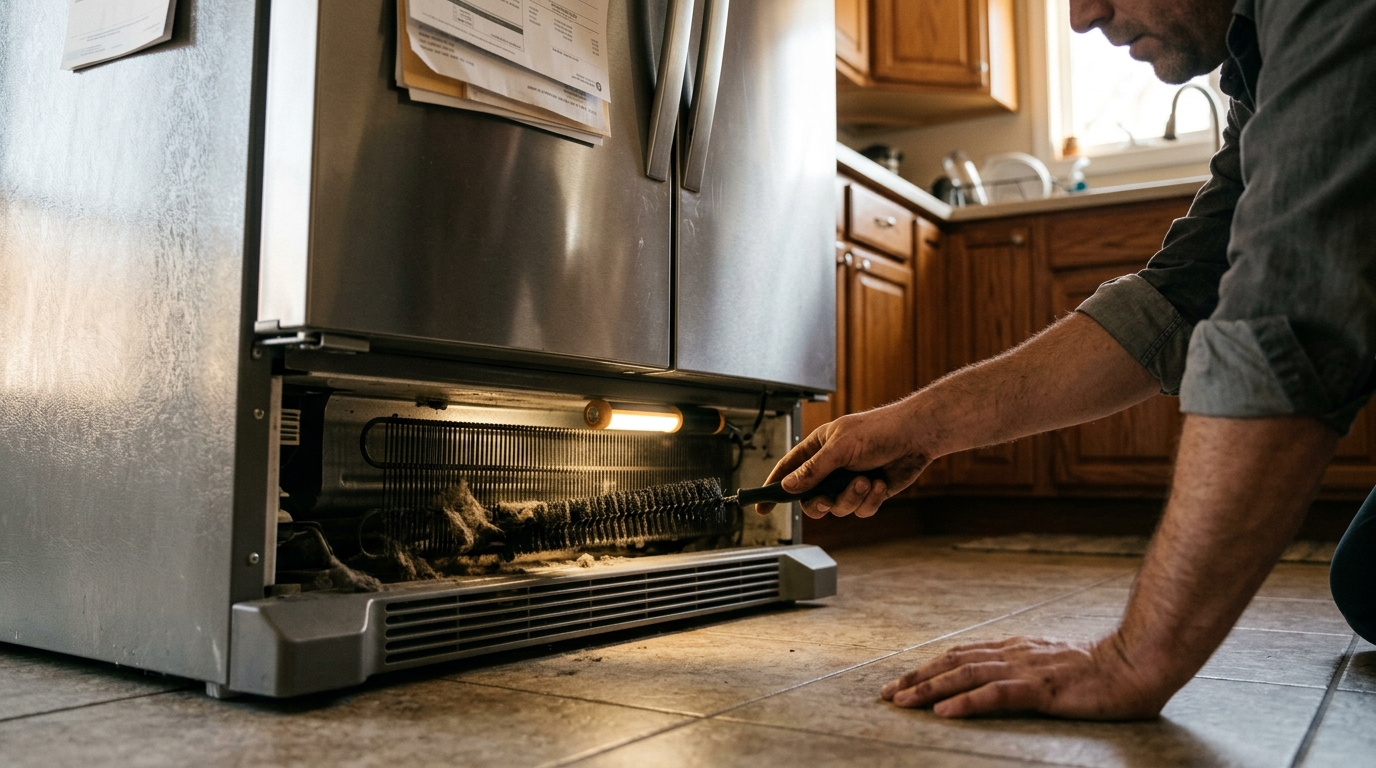
- Locate the condenser coils. On most modern fridges they are either on the back of the unit or underneath behind a kick plate at the base. Remove the kick plate by snapping or unscrewing it.
- Use a coil cleaning brush (a long flexible bristle brush available for $8 to $15 at hardware stores) to loosen dust, pet hair, and debris from the coil fins. Work slowly to avoid bending the fins.
- Vacuum all loosened debris with a crevice attachment. Also vacuum the condenser fan blades if accessible underneath the unit. A clogged fan is a common and easily overlooked cause of efficiency loss.
- While the fridge is pulled out, inspect the door gaskets closely for cracks, tears, or areas where the rubber has hardened. A new universal gasket typically costs $20 to $30 and can be pressed into the door channel without tools on many models. Replace any gasket that fails the dollar-bill test in multiple spots.
- Check that the fridge sits level or tilts very slightly backward (about a quarter inch lower at the back than the front). This lets the doors swing closed on their own, reducing the chance of leaving them slightly ajar. Adjust the leveling feet at the base with a wrench.
- Plug the unit back in, push it back into position, and document the date of maintenance in a home maintenance log or phone note.
- Find the age of your current refrigerator by locating the model and serial number inside the fridge compartment or on the back. Search the brand’s website or call their support line to get the manufacture date from the serial number.
- Look up your model’s annual energy use on the EnergyGuide label (the yellow sticker inside or on the back) or search the model number at the ENERGY STAR product finder at energystar.gov. Compare this kWh figure to current ENERGY STAR models of the same size.
- Calculate annual savings by subtracting the new model’s kWh rating from your current unit’s rating, then multiplying by your local electricity rate (check your utility bill for your cost per kWh). Divide the purchase price by annual savings to get your payback period in years.
- Choose a size appropriate for your household. A family of four needs roughly 19 to 22 cubic feet. Oversized refrigerators use more energy than necessary and a half-empty freezer cycles more often. Avoid buying bigger than you need.
- Check for utility rebates before purchasing. Many local utilities offer $50 to $200 rebates for replacing old refrigerators with ENERGY STAR certified models. Visit dsireusa.org or your utility’s website to check current incentives.
- Arrange disposal of the old unit through your utility’s appliance recycling program if available, or through the retailer. Do not keep the old unit as a secondary garage fridge unless it is a modern efficient model. An old secondary fridge can add $150 or more per year to your electric bill.
Why It Works: The Benefits
Cleaning condenser coils and adjusting the thermostat set point takes less than 20 minutes and can reduce the fridge’s energy draw by 15 to 25%, saving $20 to $45 per year with zero investment.
A compressor that runs fewer cycles lasts longer. Keeping coils clean and gaskets sealed reduces compressor runtime, potentially adding 3 to 5 years to the life of the unit and deferring a $800 to $1,500 replacement cost.
A struggling refrigerator dumps more waste heat into your kitchen, which your air conditioner then has to remove. Improving fridge efficiency can measurably reduce the cooling load in small kitchens during summer months.
A properly calibrated and well-sealed refrigerator holds a more stable internal temperature, reducing the risk of temperature spikes that spoil food. The FDA estimates food spoilage cost the average household $1,500 per year, and temperature consistency plays a direct role.
Replacing a pre-2001 refrigerator with a current ENERGY STAR model saves 400 to 600 kWh per year. At the national average electricity rate of $0.16 per kWh, that is $64 to $96 annually, with a payback period of 5 to 8 years on a mid-range replacement unit.
💰 Savings Impact by Action
Cleaning heavily fouled condenser coils can reduce compressor runtime and energy draw by 15 to 30% depending on how dirty the coils were.
Raising the refrigerator set point from 34 to 37 degrees F reduces the thermal gradient and cuts energy use by approximately 6 to 9%.
Replacing a failed door gasket eliminates continuous warm-air infiltration, reducing compressor cycling by an estimated 10 to 15%.
Replacing a pre-2001 refrigerator with a current ENERGY STAR model reduces the appliance’s annual energy consumption by 40 to 55%.
Moving a refrigerator away from direct heat sources like ovens or direct sunlight can reduce energy use by 10 to 15% by lowering the ambient temperature the compressor works against.
🏠 Key Concepts Explained
The Science Behind It
Refrigerators work on the same basic principle as your air conditioner: a compressor pressurizes a refrigerant, which releases heat as it condenses, then absorbs heat as it evaporates inside the cold compartment. The condenser coils are where that absorbed heat is released into your kitchen. When those coils are insulated by a layer of dust and hair, the heat cannot escape efficiently, so the refrigerant stays warmer, the compressor has to run longer to complete each cooling cycle, and electricity consumption climbs. The relationship is not linear either. Even a modest layer of insulating debris can increase compressor runtime by 15 to 30%.
The door gasket creates what is essentially a thermal envelope for your food, similar in principle to the insulation in your walls. When this seal is compromised, warm humid air from your kitchen infiltrates the cold interior. That warm air carries moisture, which also causes frost buildup in the freezer compartment. The refrigerator must then run longer to remove both the heat and the moisture, and frost accumulation on the evaporator coils further reduces heat transfer efficiency. It is a compounding problem that starts with something as simple as a cracked rubber seal.
Thermostat set point is a surprisingly powerful lever. The compressor works harder to maintain colder temperatures because a larger temperature differential between the interior and the ambient kitchen air means more heat flows in and must be pumped back out. This is a direct application of Fourier’s Law of heat conduction: heat transfer rate is proportional to the temperature difference. Setting your fridge to 34 degrees instead of 37 degrees may seem insignificant, but it increases the thermal gradient and can raise energy use by 6 to 9% with no meaningful food safety benefit. Hitting the FDA sweet spot of 35 to 38 degrees F is both the safest and the most efficient choice.
Frequently Asked Questions
▼ My fridge is running almost constantly. Is that normal or is something wrong?
A refrigerator should cycle on for roughly 30 to 50% of the time under normal conditions. If it runs nearly nonstop, start by checking door gaskets for leaks and cleaning the condenser coils, since these are the two most common culprits. If the problem persists after both fixes and the unit still cannot maintain 37 to 38 degrees F, you likely have a refrigerant leak, a failing compressor, or a bad evaporator fan, and you should call an appliance technician.
▼ How do I know if my old refrigerator is actually costing me more than a new one would?
Find the yellow EnergyGuide label inside your unit or look up your model number on the ENERGY STAR product finder at energystar.gov to get the estimated annual kWh. Then compare that number to a current ENERGY STAR model of the same size, which typically uses 400 to 500 kWh per year. Multiply the difference in kWh by your electricity rate to get annual savings. If your unit is pre-2001, you are likely looking at 800 to 1,200 kWh per year, which represents $60 to $115 in annual excess cost at today’s average rates.
▼ Why is there frost building up in my freezer even though I have a frost-free model?
Frost buildup in a frost-free freezer is almost always caused by warm humid air getting in, which points to a failing door gasket or a door that is not closing fully. Check the gasket with the dollar-bill test around the entire freezer door perimeter. Also check that nothing inside the freezer is blocking the door from sealing completely at the bottom. If the gasket checks out and frost persists, the defrost heater or thermostat may be failing and will need a technician.
▼ Can I keep my old fridge in the garage as a secondary beer fridge?
Only if you have carefully calculated the cost. An old pre-2000 refrigerator used as a secondary unit can add $100 to $200 per year to your electricity bill, which is often more than the value of the convenience it provides. In a hot garage above 90 degrees F, that cost climbs even higher and the unit may fail prematurely. If you want a garage fridge, a small modern ENERGY STAR mini fridge at $150 to $250 is often the smarter long-term choice.
▼ How long does it take to see savings after cleaning the coils and adjusting the thermostat?
You will see results on your very next monthly electric bill. The fridge runs continuously, so efficiency improvements show up immediately. The savings will be modest (typically $2 to $5 per month for most households) but they are consistent and compound over time. Use a smart plug with energy monitoring to track the fridge’s actual draw before and after maintenance if you want to quantify the impact precisely.
Quick Tips
- Let hot leftovers cool to room temperature before placing them in the fridge. Putting hot food directly in raises the interior temperature and triggers a long compressor cycle.
- Cover all liquids and foods stored in the fridge. Uncovered items release moisture into the air, which the unit must work to remove and which accelerates frost buildup in the freezer.
- If you go on vacation for more than a week, eat down perishables, raise the thermostat setting slightly to 40 degrees F (the maximum safe FDA temperature), and make sure the unit is full of beverages or water jugs before you leave to maintain thermal mass.
- Avoid storing the refrigerator in an unconditioned garage in hot climates unless the unit is rated for garage use. Ambient temperatures above 90 degrees F can cause the compressor to run nearly continuously and may shorten its life significantly.
Variations for Your Situation
- Apartment/Rental: Renters cannot replace appliances, but you can still clean condenser coils (check your lease or ask your landlord for permission to pull the unit from the wall), verify thermostat calibration with an inexpensive fridge thermometer ($5 to $10), and test gaskets. If the fridge is your landlord’s property and has a broken gasket or runs constantly, document it in writing and request maintenance since it is the landlord’s responsibility and a functional fridge is a habitability standard in most states.
- Tight Budget (under $50): Focus on the zero-cost steps first: adjust thermostat set points to 37 degrees F and 0 degrees F, fill the freezer with water jugs, clear the area around the unit for airflow, and do the dollar-bill gasket test. A coil cleaning brush costs $8 to $12 and a replacement universal gasket runs $20 to $30. These two purchases alone can recover 15 to 25% of the fridge’s energy cost with no other investment.
- Older Home (pre-1980): Homes of this era frequently have refrigerators that are 15 to 25 years old still in service, and replacement delivers the highest return here. If your unit is pre-2001, skip straight to the payback calculation in the Strategic Replacement approach. At $0.16 per kWh, an old unit consuming 1,000 kWh per year versus a new 450 kWh ENERGY STAR model saves $88 per year. A $1,000 mid-range replacement pays back in about 11 years, but check for utility rebates that can cut that payback period to 7 to 8 years.