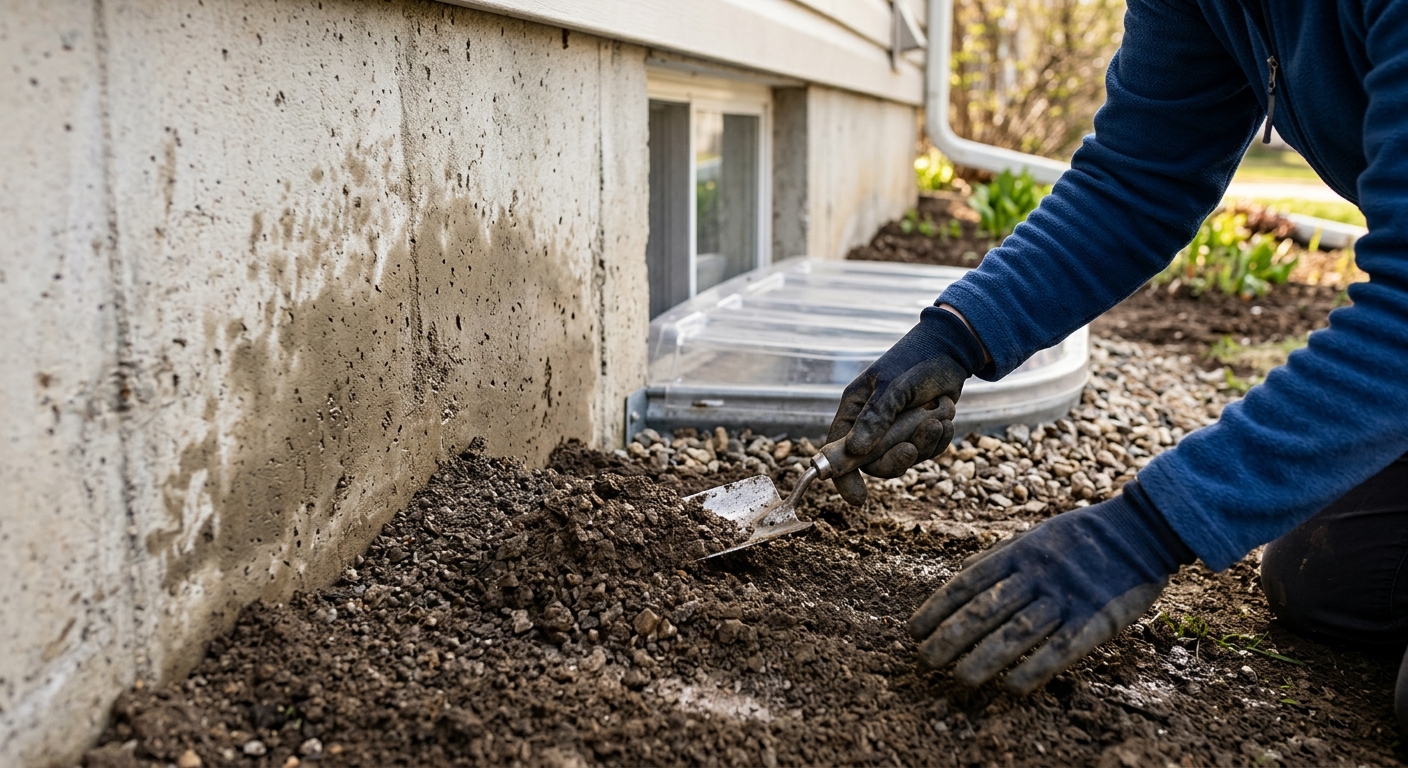
Every spring, millions of homeowners walk downstairs and find damp walls, musty smells, or even puddles on the basement floor. It feels like a plumbing problem or a waterproofing failure, but in most cases the real culprit is standing just outside your foundation wall: soil that has settled flat or slopes back toward the house, funneling snowmelt and April rain directly into the ground next to your concrete. That water saturates the soil, builds up hydrostatic pressure, and forces its way through tiny cracks, pores, and mortar joints.
The good news is that improper grading is one of the cheapest foundation problems to fix yourself. The International Residential Code recommends a minimum 6-inch drop over the first 10 feet away from the foundation, and restoring that slope with basic fill dirt can redirect hundreds of gallons of water per rainstorm away from your home. Homeowners who address grading before turning to interior drainage systems or waterproofing coatings often find those expensive follow-up measures become unnecessary entirely.
This post explains exactly why spring is when the problem shows up, what is actually happening inside your foundation wall, and how to fix the grading yourself with a few hours of weekend work, or when to call a pro for a more complete solution involving downspout extensions and swales.
What You’ll Need
Click on an item below to shop for the recommended items for this recipe on Amazon.
As an Amazon Associate, we earn from qualifying purchases.
How to Do It
- Walk the perimeter of your home after a moderate rain. Look for areas where water is pooling within 6 feet of the foundation, downspout splash zones, and soil that appears level or sloping toward the house.
- Check every downspout termination point. If any downspout ends within 4 feet of the foundation without an extension, that is your most urgent fix.
- Purchase plastic downspout extenders (available for $5 to $8 each) and attach them so water discharges at least 6 feet from the foundation. Rigid extenders pointing away from the house outperform flexible accordion-style ones, which tend to kink and pool.
- Recheck splash block placement under each downspout. Splash blocks should slope away from the house. Flip or reposition any that have settled toward the foundation.
- After the next rainstorm, recheck the same problem areas to see whether standing water has been eliminated or reduced. This tells you whether grading work is still needed.
- Call 811 (Dig Safe) at least 3 business days before moving any soil to have underground utilities marked. This is free and required by law in the US.
- Purchase clean fill dirt or a 50/50 mix of topsoil and clay-loam from a local landscaping supplier. Avoid pure topsoil or compost, which retain moisture and compress quickly. Budget roughly 1 cubic yard per 25 linear feet of foundation for a 4 to 6 inch correction.
- Remove any mulch, plants, or edging within 3 feet of the foundation. Mulch against the foundation wicks moisture directly to the wall and should be kept at least 6 inches away permanently.
- Using a flat spade and a landscaping rake, add fill dirt in 2-inch layers, tamping each layer firm with a hand tamper or by foot. Build up to create a slope of at least 6 inches of drop over the first 10 feet away from the house, which equals a 5% grade.
- Use a 4-foot level and a tape measure to verify the slope as you work. Place one end of the level against the foundation wall and confirm the far end reads clearly higher when measured from grade.
- Restore mulch and plantings, keeping mulch 6 inches clear of the foundation wall. Water the area lightly to settle the fill, then check for low spots after 48 hours and add additional material as needed.
- Recheck the grading each spring for the first 2 to 3 years as new fill continues to settle, and top off as necessary.
- Hire a landscape contractor or drainage specialist to assess the full site drainage pattern, including where water flows from neighboring properties onto yours.
- Have the contractor install a shallow swale, a gently sloped channel in the lawn, that intercepts water before it reaches the foundation and redirects it to the street, a dry well, or a downslope discharge point at least 10 feet from the house.
- If the yard has insufficient slope or is hemmed in by other structures, request a French drain installation: a perforated pipe in a gravel trench that captures subsurface water and carries it away. Typical French drain costs run $20 to $30 per linear foot installed.
- Ensure the contractor regrads the soil against the foundation to the 6-inch-per-10-foot standard as part of the same project, since drainage infrastructure is most effective when combined with correct surface grading.
- Request a written scope of work that includes a post-installation review after the first major rainstorm, and ask about any warranty on labor and materials.
Why It Works: The Benefits
Interior drain tile systems average $8,000 to $15,000 installed, and structural crack repair runs $500 to $3,500 per crack. Correcting grading for $50 to $300 in fill material stops the source of pressure before it causes structural damage.
Chronically damp basement walls maintain surface humidity above 70%, the threshold where mold colonies establish within 24 to 48 hours. Dry walls eliminate this risk and the associated air quality problems throughout the home, since basement air migrates upward into living spaces.
A wet basement adds significant latent load to your HVAC system. Keeping basement relative humidity below 60% can reduce whole-home dehumidification demand by 10 to 20%, cutting related energy costs during summer months.
Water intrusion is the leading cause of damage to finished basement spaces. A single flooding event can destroy drywall, flooring, and framing worth $10,000 to $40,000. Proper grading is the first and cheapest layer of protection.
Home inspectors flag negative grading on nearly every older home they inspect, and lenders can require correction before closing. Fixing grading proactively removes a common negotiating point that buyers use to reduce offers by $3,000 to $10,000.
💰 Savings Impact by Action
Restoring a proper 5% slope away from the foundation eliminates surface water pooling and reduces hydrostatic pressure buildup, resolving moisture intrusion in up to 70% of wet basement cases where the cause is drainage related.
Extending downspouts 6 feet or more from the foundation reduces concentrated discharge at the wall, cutting localized soil saturation by up to 30% in heavy rain events.
Keeping basement RH below 60% reduces the latent cooling load transferred to the main HVAC system by 10 to 15% during humid summer months.
Addressing grading before structural moisture damage occurs avoids foundation repair and waterproofing costs that average $8,000 to $20,000, representing a cost avoidance of over 85% compared to remediation after damage.
🏠 Key Concepts Explained
The Science Behind It
Basement walls get wet in spring through a combination of surface drainage failure and a physics phenomenon called hydrostatic pressure. When soil becomes saturated from snowmelt or heavy rain, the water does not just sit on the surface. It percolates downward until it reaches a less permeable layer, often the concrete footing itself, where it accumulates. That column of water pressing against the wall exerts pressure proportional to its depth. At just 18 inches of saturated soil against a wall, the lateral water pressure reaches roughly 56 pounds per square foot. Concrete resists compressive forces well, but it is far more vulnerable to sustained lateral water pressure pushing through pores and joints.
The reason spring is the worst season comes down to the freeze-thaw cycle. All winter, water in the soil near the foundation freezes and expands by about 9%, which shifts the soil, opens micro-cracks in mortar joints, and can widen existing hairline cracks in poured concrete. When temperatures rise in March and April, that ice melts rapidly, releasing large volumes of water all at once into soil that is already disturbed and more permeable than it was in the fall. Simultaneously, deep frost in the ground prevents percolation downward, so water has nowhere to go but sideways, straight into the foundation.
Correcting the surface grade fixes this problem by creating a drainage gradient that intercepts surface water before it can saturate the soil against the wall. A 5% slope (6 inches over 10 feet) generates enough gravitational flow to redirect the vast majority of surface water away from the foundation. For every inch of rainfall over a 200-square-foot roof section, roughly 125 gallons of water reaches the ground. Proper grading, combined with extended downspouts, ensures that water sheds to the lawn or street rather than pooling at the one spot where your basement wall is most vulnerable.
Frequently Asked Questions
▼ I fixed the grading but my basement walls are still wet. What did I miss?
If grading is correct and walls are still wet, the next most likely culprits are downspouts discharging too close to the foundation, a high seasonal water table, or a crack in the wall or footing itself. Check that all downspouts discharge at least 6 feet away, then look for white mineral deposits (efflorescence) on the interior wall, which indicate water has been moving through that specific spot for a long time. If you can identify a crack or joint where water is visibly entering, hydraulic cement applied from the interior side can stop active leaks while you plan a more permanent exterior solution.
▼ How much fill dirt do I actually need to buy?
For a typical perimeter grading correction on a standard 1,500 square foot ranch home, plan on 3 to 5 cubic yards of fill, which covers roughly 100 linear feet of foundation at a 4 to 6 inch depth over a 3-foot-wide band. One cubic yard of fill weighs roughly 1.3 to 1.5 tons, so have it delivered by truck rather than hauling it in bags. Ask your supplier for a clay-loam blend, not pure topsoil, as it compacts better and sheds water rather than absorbing it.
▼ Can I use mulch instead of fill dirt to build up the slope?
No. Mulch is the wrong material for this job because it retains moisture, compresses quickly, and actually wicks water toward the foundation rather than shedding it. Use compactable fill dirt or clay-loam to create the slope, then optionally add a thin layer of mulch on top for appearance, but keep that mulch layer at least 6 inches away from the foundation wall itself.
▼ My basement is finished with drywall. Do I need to tear it out to fix this?
Not necessarily, and you should start with the exterior grading fix first before touching any interior finishes. If the grading correction eliminates the moisture source, the finished wall may dry out on its own over one to two seasons, assuming no mold has established behind the drywall. If you see visible mold, soft drywall, or persistent staining after the exterior work is done, then yes, you will need to remove the drywall to inspect and remediate, as mold behind finished walls poses a health risk and will not resolve on its own.
▼ Is this something renters can or should do?
Renters should not modify exterior grading without written landlord approval, as it involves moving soil on the property. However, renters absolutely should document wet walls with photos and dates and submit a written maintenance request to the landlord, since persistent water intrusion is a habitability issue in most jurisdictions. Inside the unit, renters can run a dehumidifier and avoid storing items directly on the basement floor while waiting for the landlord to address the underlying drainage problem.
Quick Tips
- Check and clear window well drains every fall before freeze-up. A clogged window well drain can dump dozens of gallons directly against the foundation wall during a single storm.
- After regrading, seed the disturbed soil immediately or cover it with erosion fabric to prevent rain from washing your new fill away before it establishes.
- Paint the repaired wall area inside the basement with a hydraulic cement or masonry sealer after the exterior grading work is done. This addresses any existing porosity while the exterior fix prevents new water from building pressure.
- Consider running a dehumidifier in the basement set to 50 to 55% relative humidity during the spring season while you monitor whether the grading fix resolved the moisture problem. This protects stored items and prevents mold during the evaluation period.
Variations for Your Situation
- Apartment or Condo: Residents in multi-unit buildings cannot address exterior grading themselves, but they should report moisture issues in writing to building management and request documentation of the response. Inside, use a dehumidifier rated for the square footage of the space (typically 30 to 50 pints per day for a 500 to 1,000 sq ft basement) and keep it set to 50 to 55% RH. Avoid storing anything organic, cardboard boxes, wood furniture, or fabric directly on a slab floor.
- Tight Budget (under $50): Skip the fill dirt delivery and focus entirely on free or low-cost wins first. Reposition existing splash blocks, add $8 plastic downspout extenders to every downspout, and clear any debris from window well drains. These three steps alone reduce water input at the foundation significantly and cost under $40. Then monitor through one full rainy season before investing in fill material.
- Older Home (pre-1980): Homes built before modern codes often have no dampproofing on the exterior of the foundation wall, meaning the concrete itself is the only moisture barrier. Grading correction is even more critical for these homes because there is no backup membrane. Start with the grading and downspout fixes, then consider applying a brush-on interior masonry waterproofing product such as DRYLOK or RadonSeal to the interior wall surface, which costs $30 to $80 for a one-gallon can and provides meaningful protection in the absence of exterior dampproofing.