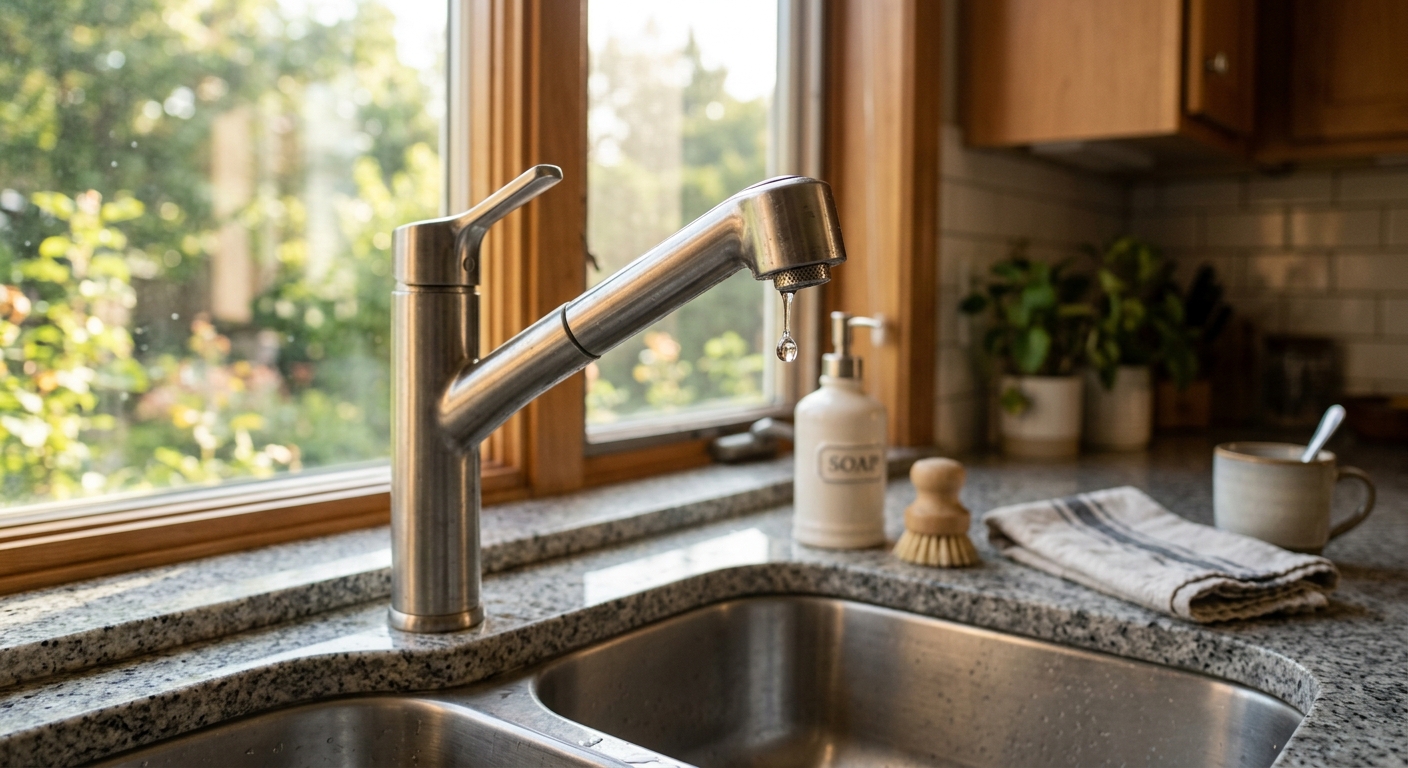
That slow, rhythmic drip from your bathroom or kitchen faucet might seem harmless, but the numbers tell a different story. According to the EPA, a faucet that drips just once per second wastes more than 3,000 gallons of water every year. That is roughly the amount of water needed for over 180 showers. Multiply that across a typical home with two or three leaky fixtures, and you are quietly pouring hundreds of dollars down the drain every year.
Beyond the water bill, a leaking hot-water faucet is also wasting energy. Your water heater is constantly working to replace the heat lost in those drips, which can add another $10 to $20 annually per faucet in heating costs alone. Over five years, one ignored drip can cost a homeowner $150 to $275 in combined water and energy waste.
In this guide, we will walk you through exactly how to identify why your faucet is leaking, what parts you need, and how to fix it yourself with basic tools in under an hour. We cover both quick temporary fixes and the proper long-term repair, along with guidance on when it makes sense to call a plumber instead.
What You’ll Need
Click on an item below to shop for the recommended items for this recipe on Amazon.
As an Amazon Associate, we earn from qualifying purchases.
How to Do It
- Turn off the water supply valves under the sink by rotating them clockwise until snug. Test the faucet to confirm flow has stopped.
- Tighten the packing nut just below the handle using an adjustable wrench. Turn clockwise one quarter to one half turn. Do not overtighten, as this can damage the stem.
- Reassemble and slowly turn the supply valves back on. Check whether the drip has slowed or stopped.
- If the drip persists, note the faucet brand and model (usually stamped on the faucet body or handle) so you can order the correct replacement parts.
- Place a small bucket under the spout overnight to measure the drip volume and confirm the severity before deciding on next steps.
- Turn off the hot and cold supply valves under the sink fully. Open the faucet to release pressure and drain remaining water from the line.
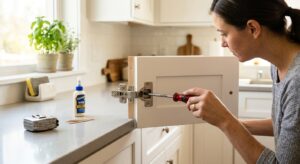
- Remove the handle by prying off the decorative cap on top, then unscrewing the screw underneath. Pull the handle straight up or wiggle it gently off the stem.
- For compression faucets: unscrew the packing nut with an adjustable wrench, pull out the stem, and replace the rubber washer at the bottom held by a brass screw. Inspect the seat inside the faucet body. If it feels rough or pitted, use a seat wrench to replace it.
- For cartridge faucets: remove the cartridge retaining clip with needle-nose pliers, pull the cartridge straight up, and insert a new cartridge in the same orientation. Replace all O-rings on the cartridge body.
- For ball-type faucets: use a faucet repair kit specific to your brand. Replace the ball, springs, seats, and O-rings as a set. Reassemble in reverse order.
- Reassemble the handle, turn the supply valves back on slowly, and test for drips. Run both hot and cold to check all seals before calling the repair complete.
- Document the leak by taking photos and noting the faucet brand, finish, and age before calling. This helps the plumber arrive with the right parts.
- Request quotes from two or three local licensed plumbers. A standard single-faucet repair should take under one hour. Be cautious of quotes over $200 for a basic drip repair.
- Ask the plumber to inspect the supply stop valves under the sink while on-site. If those valves are older than 15 years or did not shut off completely during your DIY attempt, have them replaced at the same visit for $20 to $40 in parts.
- If the plumber recommends full faucet replacement, consider a WaterSense-labeled model, which uses 30% less water than standard faucets and may qualify for a utility rebate of $5 to $25.
- After the repair, check the water meter reading before and after a one-hour period of no water use to confirm the leak is fully resolved.
Why It Works: The Benefits
Fixing one dripping faucet immediately stops the loss of 3,000 to 5,000 gallons per year, which translates to $20 to $35 saved on the average U.S. water bill.
Stopping a hot-water drip prevents the water heater from compensating for continuous heat loss, saving an additional $10 to $20 per year per fixture in gas or electric costs.
Persistent drips cause staining, mineral deposits, and corrosion in sinks. Over time, water that splashes or seeps beneath fixtures can damage cabinet bases, leading to mold and wood rot repairs that cost hundreds of dollars.
A dripping faucet in a bathroom or kitchen is a constant background irritant, especially at night. A five-minute repair permanently eliminates the sound.
Replacing a worn washer or cartridge for $5 to $15 can restore years of service to a quality faucet, delaying the need for a full replacement that costs $80 to $400 installed.
💰 Savings Impact by Action
Fixing one dripping faucet eliminates up to 3,000 gallons of annual water waste, reducing household water bills by roughly 10% for a typical family of four.
Stopping a hot-side drip reduces water heater workload, saving 5% or more on water heating energy costs depending on drip rate and heater type.
Replacing an old faucet with a WaterSense-certified model uses at least 30% less water per minute while maintaining equivalent pressure and performance.
Reducing household water pressure from 100 psi to 60 psi can cut overall water consumption by up to 15% and significantly extend the life of faucet seals and washers.
🏠 Key Concepts Explained
The Science Behind It
Every dripping faucet is a failure of a pressurized seal. Your home’s water supply is maintained at 40 to 80 psi of pressure at all times. The sole job of a faucet’s internal components, whether a rubber washer, ceramic disc, or cartridge, is to create a watertight barrier against that constant pressure when the handle is closed. When those components wear down, even a microscopic gap allows pressurized water to push through, producing the drip you hear.
The physics of water loss are deceptively severe. One drip per second sounds trivial, but each drip averages about 0.25 milliliters. At one drip per second, that adds up to roughly 21,600 milliliters, or 5.7 gallons, per day. Over a year, that single faucet deposits 2,082 gallons down the drain. Real-world drip rates are often faster, which is why the EPA’s commonly cited figure is 3,000 gallons annually for a typical household faucet leak. If the leaking faucet is on the hot water line, the energy loss compounds: your water heater must replenish heat continuously, consuming an estimated 0.5 to 1.5 therms of gas or 15 to 45 kWh of electricity per year per dripping fixture.
Hard water accelerates every form of faucet wear. Calcium carbonate deposits form a gritty layer on rubber seals and ceramic valve faces, acting like fine sandpaper with every open-and-close cycle. Over time this abrades the seating surface until no amount of handle pressure can force a proper seal. This is why homes in hard-water regions like the Southwest, Midwest, and Mid-Atlantic states see faucet components fail two to three times faster than homes with soft water. Installing a whole-house water softener or a faucet-mounted filter can significantly extend the life of your replacement parts.
Frequently Asked Questions
▼ I replaced the washer but the faucet is still dripping. What did I miss?
The most common cause is a damaged valve seat, the metal surface inside the faucet body that the washer presses against. If the seat is pitted or rough from corrosion, it will chew through a new washer quickly. Use a seat wrench (about $8 at hardware stores) to remove and replace the seat, or use a seat-dressing tool to resurface it. Also confirm you installed the correct washer size and that it is seated flat with the retaining screw fully tightened.
▼ Water is leaking from the base of the handle, not the spout. Is that a different fix?
Yes. A leak at the base of the handle typically means a worn O-ring on the faucet stem or cartridge body, not the washer. Disassemble the handle as described in the DIY approach, locate the O-rings on the stem, and replace them with matching sizes coated in plumber’s grease. This repair takes about 15 minutes once you have the correct O-ring size.
▼ My shut-off valve under the sink would not close fully. What should I do?
Do not force a stuck valve. Turn off the main house water supply instead before proceeding with the faucet repair. While you have the water off, plan to replace the stop valve. A quarter-turn ball valve ($8 to $15) is far more reliable than older multi-turn compression valves and will make future repairs much easier. If you are uncomfortable soldering or using push-fit connectors, this is a good task for a plumber to handle during the same visit.
▼ How long before I actually see savings on my water bill?
Your next full billing cycle, typically 30 to 60 days after the repair, should reflect measurably lower usage. For perspective, a 3,000-gallon annual leak averages about 250 gallons per month. At the U.S. average water rate of roughly $0.01 per gallon, that is $2.50 per month per faucet, which shows clearly as a usage reduction on your bill even before considering hot water energy savings.
▼ Can I fix a leaky faucet in an apartment without the landlord’s permission?
In most states, you are legally entitled to notify your landlord of a leak in writing and request repair within a reasonable timeframe (typically 14 to 30 days). Attempting DIY plumbing repairs in a rental without permission can void your lease or make you liable for further damage. Report the leak promptly in writing and keep a copy. If the landlord fails to act, many states allow tenants to deduct repair costs from rent after following proper notice procedures.
Quick Tips
- Check all faucets in your home twice a year by placing a dry paper towel under each spout for 30 seconds with the handle fully closed. Any moisture indicates a leak worth fixing.
- Read your water meter before bed and again first thing in the morning before any water is used. If the reading changed, you have a leak somewhere in the house.
- Apply a thin coat of plumber’s grease to all new O-rings and washers before installation. Dry rubber tears easily during assembly and can cause an immediate re-leak.
- If your home has water pressure above 80 psi (check with a $10 pressure gauge at an outdoor hose bib), install a pressure-reducing valve. High pressure is the leading cause of recurring faucet leaks and washer failures.
Variations for Your Situation
- Apartment/Rental: Renters cannot legally modify plumbing without landlord approval in most leases. Report the leak in writing immediately and keep a dated copy for your records. While waiting for repairs, place a bowl to catch drips and track the volume to document water waste. If your landlord is unresponsive after 14 days, research your state’s tenant repair-and-deduct laws. Some utility companies will credit your account for documented leak waste if you provide the repair receipt.
- Tight Budget (under $20): A basic compression faucet washer kit costs $3 to $6 and covers most older single-handle and two-handle faucets. Skip the plumber’s grease for now and use a small dab of petroleum jelly instead. The $0 tighten-and-inspect approach described above should always be your first step. In many cases, simply snugging the packing nut one quarter turn stops a mild drip entirely at no cost.
- Older Home (pre-1980): Faucets in homes built before 1980 are almost always compression-type and may use non-standard washer sizes. Bring the entire stem assembly, not just the washer, to the hardware store to match parts. If the faucet is original to the home and parts are unavailable, a full faucet replacement is often more cost-effective than hunting for obsolete components. Budget $60 to $120 for a quality replacement faucet plus $75 to $150 for professional installation if you are not comfortable with soldering or supply line connections.