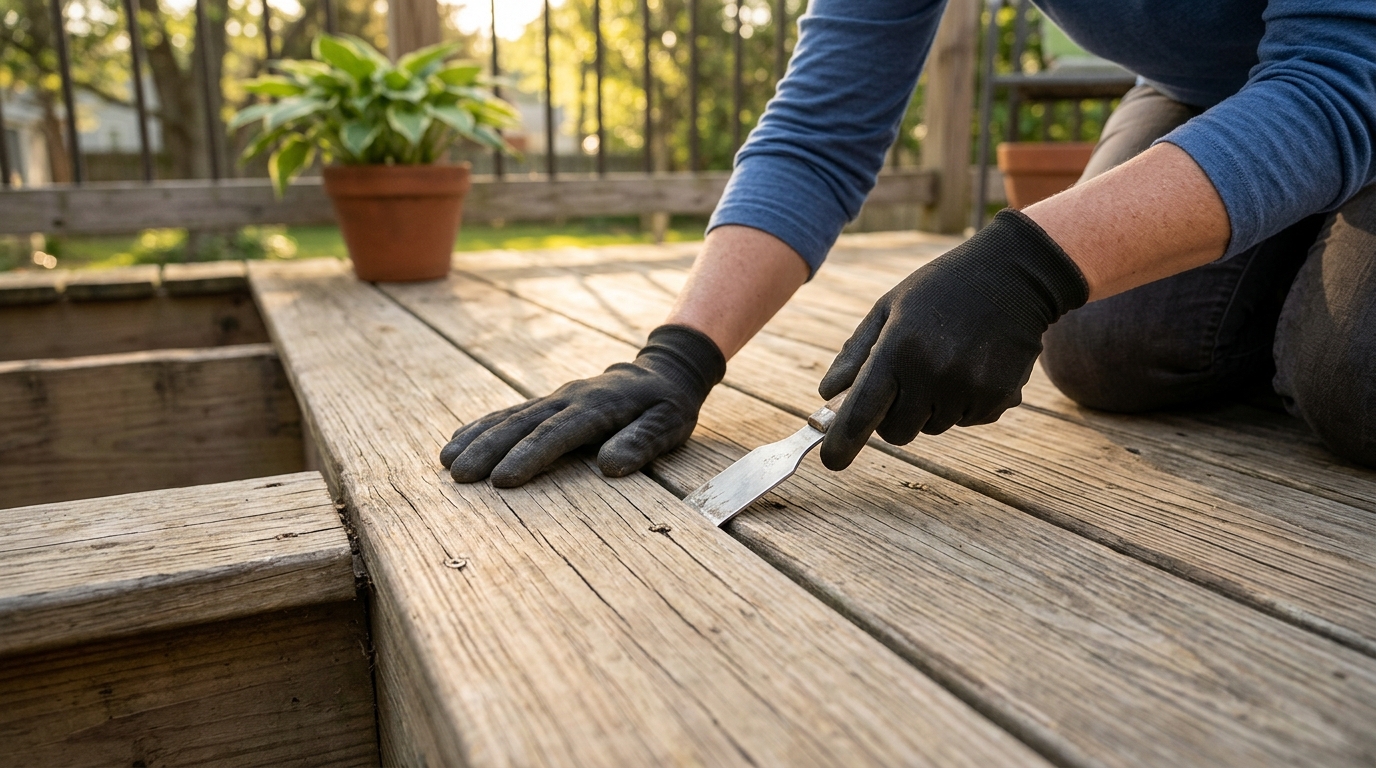
Your deck takes a beating year-round. UV rays bleach and crack the wood surface, rain and snow drive moisture into joints and fasteners, and freeze-thaw cycles expand and contract every board and beam. Most of the damage happens slowly and invisibly, which is why a deck that looks fine from a lawn chair can have serious structural problems hiding just underneath. According to the North American Deck and Railing Association, an estimated 40 million decks in the U.S. are considered unsafe, and the majority of failures are tied to rot, corroded fasteners, and improper ledger connections.
The good news is that catching these problems early is straightforward and costs almost nothing. A 30-minute annual inspection with a few basic tools lets you identify soft spots, failing hardware, and drainage problems before they become structural failures. Replacing a single rotted joist runs $200 to $500 in materials. Replacing an entire deck runs $15,000 to $35,000. The math on spending half an hour each spring is obvious.
This guide walks you through two levels of deck inspection: a quick visual and probe check any homeowner can do in under 30 minutes, and a more thorough DIY assessment that covers hidden structural components and gives you a repair priority list. You will know exactly what to look for, what the warning signs mean, and when to call in a licensed contractor.
What You’ll Need
Click on an item below to shop for the recommended items for this recipe on Amazon.
As an Amazon Associate, we earn from qualifying purchases.
How to Do It
- Walk the entire deck surface slowly and feel for soft, spongy, or bouncy boards underfoot. Mark any problem areas with chalk or tape so you can find them again.
- Use a flathead screwdriver to probe the end grain of deck boards, posts, and the ledger board where it meets the house. Push firmly – the screwdriver should not penetrate more than 1/4 inch. Deeper penetration means active rot.
- Inspect every railing post by grabbing it firmly and pushing side to side and front to back. Any movement greater than about 1/4 inch at the top of a 36-inch railing is a failure. Check that balusters are secure and spaced no more than 4 inches apart.
- Look underneath the deck at the beam, joist hangers, and post bases. Look for orange rust staining, missing fasteners, cracks in the wood, or joist hangers that have pulled away from the framing.
- Check the ledger board connection where the deck attaches to the house. Look for rotted wood, gaps between the ledger and house, missing lag screws, and staining or moisture damage on the house siding just above the ledger.
- Clear debris from between deck boards and from around post bases and beam ends. Debris traps moisture and accelerates rot right at the most vulnerable points.
- Complete the full 30-minute visual and probe inspection first to identify all suspect areas before starting hands-on work.
- Use a moisture meter on any boards that felt soft or showed surface cracking. Readings above 20% moisture in a board that should be dry indicate rot risk. Replace boards reading above 25% even if they still feel firm.
- Inspect every structural fastener you can see: joist hanger nails, lag screws at the ledger, post cap bolts, and carriage bolts through beam-to-post connections. Tap each with a hammer – a dull thud instead of a sharp ring can indicate a corroded fastener that has lost clamping force. Replace any fastener that shows heavy rust, is loose, or is missing.
- Check that the ledger is properly flashed. Slide a thin putty knife between the flashing and the house siding above the ledger. If water has gotten behind the flashing, you will see staining or soft wood. Improperly flashed ledgers are the single most common cause of hidden rot on otherwise good-looking decks.
- Tighten or replace any loose deck screws and re-drive or replace popped nails. Pre-drill and use 3-inch exterior-rated deck screws to pull down boards that have cupped or crowned more than 1/4 inch.
- Apply a penetrating wood sealer or deck stain to any bare, gray, or checked wood surfaces after confirming the wood is dry. A moisture meter reading of 15% or below is suitable for coating. Sealing extends board life by 3 to 5 years per application by blocking UV and reducing water absorption by up to 90%.
- Hire a licensed contractor or certified deck inspector (look for NADRA-certified inspectors at nadra.org) to perform a formal structural review.
- Request that the inspector evaluate the ledger connection, post footings and their depth relative to local frost line, beam sizing relative to span, and joist hanger conditions – these are the four components most commonly deficient on older decks.
- Ask for a written report with a priority list: immediate safety concerns, recommended repairs within 12 months, and items to monitor annually. This document is also useful for insurance and resale purposes.
- Get at least two contractor bids for any repairs identified. A structural report from an inspector who does not do the repairs gives you unbiased findings and stronger negotiating position.
Why It Works: The Benefits
Catching a rotted post or corroded ledger bolt early costs $50 to $300 to fix. Ignoring it until the structure fails can mean full deck replacement at $15,000 to $35,000, plus potential liability if someone is injured.
A well-maintained pressure-treated wood deck lasts 25 to 40 years. Without annual inspection and sealing, the same deck may need major repairs or replacement in 10 to 15 years, cutting its useful life nearly in half.
Deck collapses and injuries are a known liability exposure. Documented annual inspections and timely repairs can support insurance claims and may help you avoid policy complications if a guest is ever injured on your property.
A deck in poor condition is a red flag for buyers and inspectors. A clean, structurally sound deck adds an estimated 65 to 90% of its cost to resale value according to Remodeling Magazine’s Cost vs. Value report, while a failing deck can actually reduce offers.
The U.S. Consumer Product Safety Commission estimates that decks and porches cause roughly 224,000 injuries annually. A 30-minute check confirms your family and guests are not standing on a structure with hidden structural problems.
💰 Savings Impact by Action
Replacing a single rotted joist or post at $200 to $500 avoids full deck replacement at $15,000 to $35,000, representing up to 90% cost avoidance when problems are caught early.
Applying a quality penetrating sealer reduces water absorption by up to 90% and can extend deck board life by 40% compared to unprotected wood in the same climate.
Replacing corroded structural hardware at $30 to $80 per connection point avoids joist hanger failures that require full joist replacement, cutting repair costs by roughly 30 to 50% per incident.
Keeping the deck surface and understructure clear of debris improves drying time after rain and can reduce moisture-related deterioration rates by an estimated 15 to 20% over a decade.
🏠 Key Concepts Explained
The Science Behind It
Wood rot is caused by fungi, and fungi need four things to thrive: oxygen, warmth, a food source (the wood itself), and moisture above about 20% content. You cannot eliminate oxygen or warmth outdoors, and you cannot change what your deck is made of, so moisture control is the only lever you have. This is why the entire inspection focuses on identifying where water is getting in and staying in longer than the wood can tolerate. End grain is the most vulnerable because it acts like a bundle of straws, wicking water deep into the board far faster than the face grain.
Fastener corrosion follows a similar logic. Modern pressure-treated lumber uses copper-based preservatives like ACQ (alkaline copper quaternary) that are highly corrosive to standard steel hardware. Galvanic corrosion occurs when copper in the wood reacts electrochemically with the zinc coating on standard fasteners, accelerating the breakdown of the protective layer. Once the zinc coating fails, bare steel corrodes rapidly in the wet environment near treated wood, and a bolt that looks intact from the outside may have lost 40 to 60% of its cross-sectional area. This is why tapping fasteners with a hammer and listening for a dull thud rather than a sharp ring is a meaningful field test – it detects fasteners that have corroded internally and lost their clamping force.
The ledger connection failure risk is a structural load path issue. A typical 12-by-16-foot deck can carry 3,000 to 4,000 pounds of live load. All of that force transfers through the ledger bolts into the house rim joist. If the ledger itself has rotted, if the house rim joist behind it has rotted due to missing flashing, or if the lag screws have corroded, the load path fails suddenly and without warning. Building codes now require through-bolts or structural screws at prescribed spacings specifically because lag screws alone were shown to be inadequate in collapse investigations. Understanding this is why the ledger gets its own dedicated step in every inspection approach.
Frequently Asked Questions
▼ My deck boards look fine but feel spongy when I walk on them. What does that mean?
Spongy surface boards almost always mean the joists or blocking beneath them have rotted, not the boards themselves. Pull up one or two of the soft boards to inspect the joists directly below. Probe the joist top edges and the joist hanger connection points. If multiple joists are soft, you are looking at a joist replacement project costing $500 to $2,500 depending on scope, which is still far less than a full deck rebuild.
▼ How do I know if my deck needs a permit to repair?
Most jurisdictions require a permit any time you replace structural members (joists, beams, posts, ledger), change the footings, or alter the railing system. Simple board replacements and fastener repairs are usually exempt. Check with your local building department before starting any structural repair work – unpermitted structural repairs can create problems at resale and may not be covered by your homeowner’s insurance if there is a subsequent failure.
▼ My deck is only 5 years old. Do I really need to inspect it this soon?
Yes, and especially so. The first few years are when improper flashing, missing fasteners, or inadequate post footings show their first symptoms. Problems caught at year 5 are almost always inexpensive fixes. Problems discovered at year 10 or 15 are frequently structural. A 5-year-old deck that passes inspection also gives you a clean baseline to compare against in future years.
▼ What if I find rot at the ledger? Can I fix it myself?
Ledger rot repairs are not a typical DIY project and most municipalities require a permit for this work. The repair involves removing the existing ledger, inspecting and potentially sistering the house rim joist behind it, installing proper flashing, and re-attaching the ledger with code-compliant hardware. Get at least two licensed contractor bids and ask to see their permit pulled before work begins. This is a safety-critical repair that directly affects whether the deck stays attached to the house.
▼ Can I just paint over gray, weathered deck boards instead of replacing them?
Graying and surface checking are cosmetic and do not require replacement as long as the wood is structurally sound when probed. Clean the surface with a deck brightener, let it dry to below 15% moisture content (check with a moisture meter), and apply a penetrating sealer or solid color deck stain. Do not paint over rotten or structurally compromised wood – paint hides the problem and traps moisture, accelerating the decay underneath.
Quick Tips
- Do your inspection in the morning when surfaces are dry and shadows are low, making it easier to spot cracks, soft spots, and surface checking in raking light.
- Take photos of every defect you find and keep them in a folder dated by year. Comparing photos year over year shows you whether a problem is stable or progressing rapidly.
- If your deck boards have cupped so that water pools on the surface instead of draining, consider replacing them face-down, which puts the straighter bark side up and is more resistant to cupping.
- A deck built before 2004 may have been built with CCA (chromated copper arsenate) treated lumber, which is no longer sold for residential use due to arsenic content. Do not sand or burn old pressure-treated lumber without confirming the treatment type.
Variations for Your Situation
- Apartment or Condo Balcony: You are not responsible for structural repairs but you are responsible for reporting problems. Walk your balcony and probe any wood elements you can access. Check railing security by applying firm lateral pressure. Photograph any soft spots, rust staining, cracked concrete, or railing movement and submit a formal written maintenance request to your property manager immediately. Document everything in writing for liability protection.
- Tight Budget (under $50): Focus entirely on the 30-minute visual and probe inspection using only a screwdriver and a hammer you likely already own. Your highest-value free action is clearing debris from around post bases and between boards to improve drainage and drying. A $10 to $15 tube of exterior wood filler handles minor cracks, and a $20 can of penetrating deck sealer protects exposed end grain. Skip the moisture meter and refinishing for now, but do not skip the structural probe of posts, ledger, and railings.
- Older Deck (pre-2000 construction): Decks built before modern building codes may lack proper ledger flashing entirely, may use undersized hardware, and almost certainly used CCA-treated lumber. Prioritize the ledger connection and post bases in your inspection since these were the most commonly under-built components in that era. If you find any significant rot at the ledger or more than one failed post base, invest in a professional inspection report before spending money on surface repairs. A structural deficiency in an older deck often means the cost-effective path is a full rebuild rather than piecemeal repairs.