Most homeowners never think about their wiring until something goes wrong. But electrical problems rarely appear out of nowhere. They develop over months or years, broadcasting warning signs that are easy to recognize once you know what to look for. A flickering light, a warm outlet cover, or a breaker that trips too often are not just annoyances. They are your home telling you something is wrong behind the walls.
According to the National Fire Protection Association, electrical fires cause more than 51,000 home fires each year, injuring roughly 1,400 people and killing nearly 500. The financial toll averages $1.3 billion in direct property damage annually. What makes this especially sobering is that the majority of these fires are preventable with early detection and routine attention to the electrical system.
This guide walks you through a systematic, room-by-room approach to identifying wiring problems before they become dangerous. You will learn what warning signs to look for, how to do a basic DIY audit of your electrical system, and when to stop and call a licensed electrician. Whether your home was built in 1965 or 2005, these steps apply and could save your home from a preventable disaster.
What You’ll Need
Click on an item below to shop for the recommended items for this recipe on Amazon.
As an Amazon Associate, we earn from qualifying purchases.
How to Do It
- Walk every room and use your nose first. A persistent burning smell near any outlet, switch, or appliance connection is a serious red flag requiring immediate professional inspection. Do not ignore any electrical burning odor.
- Check every outlet and switch cover plate by placing the back of your hand near the surface without touching it. A warm or hot cover plate indicates current leaking into the wall or a loose connection generating resistance heat.
- Look at every visible outlet for discoloration, scorch marks, or a slightly melted appearance around the slots. Any darkening around an outlet face means arcing has already occurred there.
- Test every outlet in bathrooms, kitchens, garages, and outdoor areas using a simple outlet tester. These rooms require GFCI protection by code. A non-GFCI outlet within 6 feet of a water source is a code violation and a shock hazard.
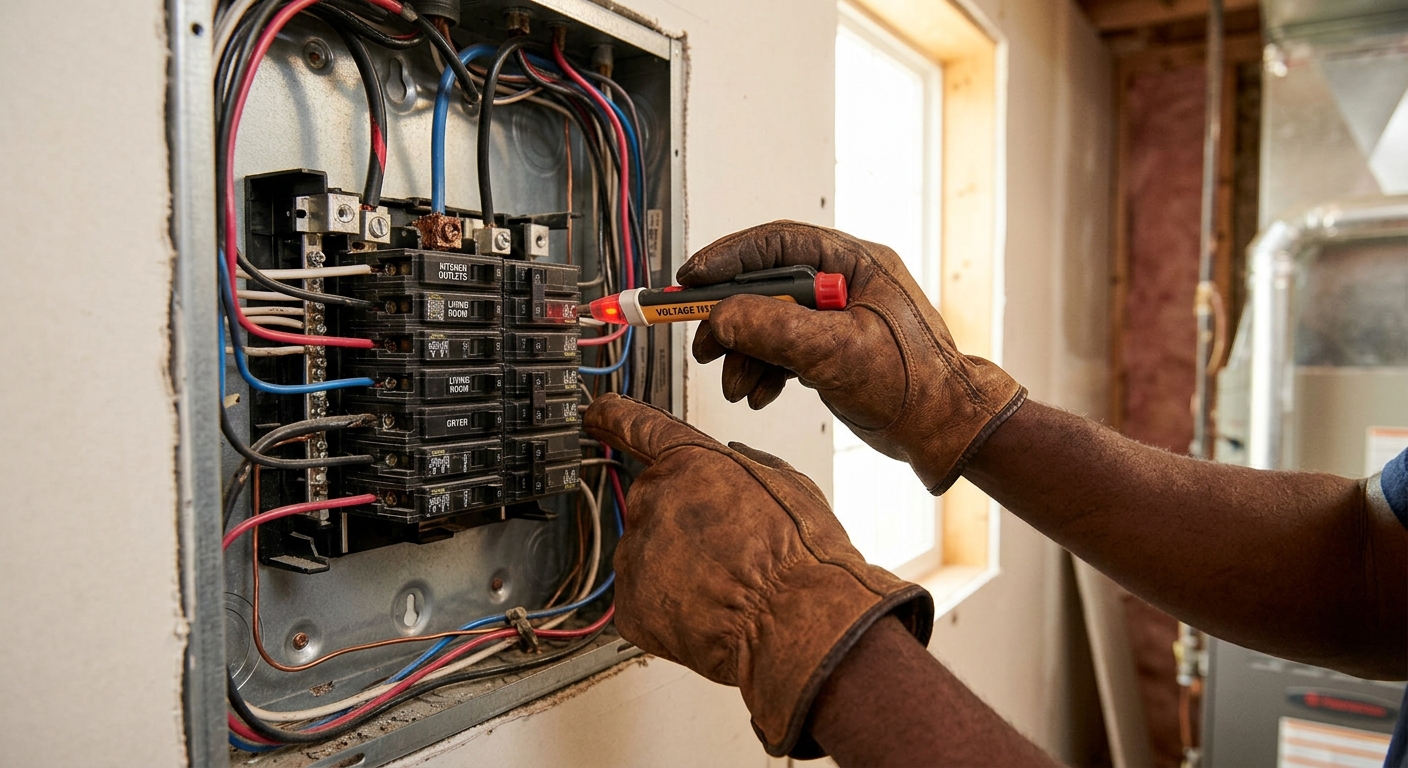
- Go to your breaker panel and look for breakers that are in the tripped position, are warm to the touch, or show any signs of corrosion or melting. A breaker that trips repeatedly for no obvious reason is failing or protecting a seriously overloaded circuit.
- Note all two-prong outlets in your home. These are ungrounded circuits, common in pre-1965 homes, and cannot safely run modern appliances or electronics. Document their locations for priority upgrading.
- Replace standard outlets in kitchens, bathrooms, garages, and outdoors with GFCI outlets. A single GFCI outlet costs $15 to $25 and can protect all downstream outlets on the same circuit when wired correctly. Turn off the breaker, verify dead with a voltage tester, and follow the line/load labeling on the GFCI device.
- Replace any outlet or switch that is warm, discolored, or sparks when you plug something in. Turn off the circuit breaker, verify with a voltage tester, remove the old device, inspect the wire connections for signs of melting or char, and install a new outlet. If you see melted wire insulation inside the box, stop and call an electrician.
- Install tamper-resistant outlets in any rooms used by children. These cost $3 to $5 more than standard outlets and are now required by the NEC in all new residential construction.
- Upgrade your most used circuits to AFCI breakers if your panel accepts them. An AFCI breaker costs $35 to $55 and detects arc faults that standard breakers cannot. Bedrooms are required to have AFCI protection in homes built after 2002, but retrofitting older homes adds significant protection.
- Label every breaker in your panel accurately. Turn on one light or appliance per circuit, then trip breakers one at a time until it goes off. Accurate labeling lets you shut off specific circuits quickly in an emergency and helps any electrician you hire work safely and efficiently.
- Install a plug-in carbon monoxide and smoke alarm combination unit in the main hallway if you have not already, and test all existing smoke alarms. Electrical fires often smolder inside walls for minutes or hours before breaking into open flame.
- Hire a licensed electrician for a whole-home electrical inspection. This typically takes 2 to 4 hours and costs $200 to $500. The electrician will check panel condition, wiring type, grounding, GFCI and AFCI coverage, and load balance across circuits.
- Request a written report of all deficiencies found, organized by severity. Ask specifically about the age and type of wiring, the panel brand and whether it is on any recall or known-defect lists, and the current amperage capacity of your service.
- If the home has a Federal Pacific Stab-Lok or Zinsco panel, prioritize replacing it immediately. These panels are documented to fail to trip under fault conditions. Panel replacement typically costs $1,500 to $3,500 and eliminates one of the highest-risk electrical hazards in residential homes.
- If aluminum branch-circuit wiring is present (common in homes built between 1965 and 1973), ask about co-wire-nutting or COPALUM crimp connector remediation at every device connection. Full rewiring of aluminum circuits costs $3,500 to $10,000 depending on home size but dramatically reduces fire risk.
- After any major electrical work, have the municipality inspect and sign off on a permit. This ensures the work meets current code, protects your homeowners insurance coverage, and provides documentation that adds value at resale.
Why It Works: The Benefits
Identifying and correcting wiring faults eliminates the primary ignition source in electrical fires. Homes with updated wiring and AFCI breakers see up to a 55% reduction in arc-fault-related fire risk according to CPSC data.
Many insurers offer premium discounts of 5 to 15% for homes with updated electrical panels, GFCI and AFCI protection, and documented electrical inspections. On a $1,800 annual premium, that is $90 to $270 back per year.
Faulty connections and overloaded circuits generate heat, which is wasted energy. Correcting loose connections and right-sizing circuits can reduce phantom electrical losses, contributing to modest 1 to 3% reductions in total electricity bills.
Unstable voltage from loose neutrals and failing wiring degrades electronics, motors, and appliances over time. Stable, properly wired circuits can extend appliance lifespans by years and prevent hundreds of dollars in premature replacement costs.
Homes with updated, documented electrical systems typically sell faster and for 2 to 3% more than comparable homes with deferred electrical work. Buyers and inspectors flag electrical deficiencies as major negotiating points.
💰 Savings Impact by Action
Arc-fault circuit interrupter breakers reduce arc-fault-related electrical fire ignition risk by up to 55% according to CPSC research.
Installing GFCI protection in wet areas eliminates up to 70% of electrocution risk in those locations by detecting ground faults in under 5 milliseconds.
Replacing a known-defective panel such as Federal Pacific can reduce homeowners insurance premiums by 10 to 15% annually on policies that previously surcharged for the hazard.
Full rewiring of a knob-and-tube or aluminum-wired home reduces insurance premiums by 10 to 12% per year while eliminating the highest-risk wiring configurations.
Tightening loose connections at outlets, switches, and the panel reduces resistance-based energy waste, cutting phantom electrical losses by roughly 1 to 3% on affected circuits.
🏠 Key Concepts Explained
The Science Behind It
Most people assume a breaker will always save them from a wiring fire. This is a common and dangerous misconception. Standard circuit breakers are designed to detect overcurrent, meaning they trip when too many amps flow through the circuit. But the most common cause of electrical fires is not overcurrent. It is arc faults, which occur when electricity jumps across a gap in damaged or loose wiring. An arc can generate temperatures exceeding 10,000 degrees Fahrenheit while drawing only a small fraction of the current needed to trip a breaker. The breaker never knows anything is wrong. Meanwhile, the arc has ignited the wood framing or insulation surrounding the wire.
Resistance heating is the second major mechanism. Every electrical connection has some resistance, but a loose connection, a corroded terminal, or a damaged wire dramatically increases it. By Joule’s Law, heat generated at a connection is proportional to the square of the current times the resistance. Even a small increase in resistance at a high-current connection (like a dryer outlet or a double-pole breaker) can generate enough sustained heat to char the surrounding materials over weeks or months. This is why outlets and switch plates that feel warm are such a serious warning sign. The heat you feel through the cover plate means the temperature inside the wall box is considerably higher.
Grounding and bonding are the last line of defense. When wiring fails in a way that puts voltage on a metal appliance body or a metal water pipe, a proper ground conductor provides a low-resistance return path for that fault current. This causes a large surge of current that trips the breaker quickly. Without a ground path, that dangerous voltage has nowhere safe to go and waits for a person to complete the circuit. This is why two-prong ungrounded outlets are a significant hazard for modern appliances, and why GFCI outlets are critical near water. A GFCI monitors the difference between current leaving and returning on a circuit and trips in as little as 4 to 5 milliseconds when it detects an imbalance as small as 5 milliamps, well before that current level can cause cardiac arrest.
Frequently Asked Questions
▼ My lights flicker occasionally but everything seems fine. Should I be worried?
Occasional flickering that is isolated to one fixture is usually a loose bulb or a failing light switch, both easy fixes. But flickering that affects multiple rooms, occurs when large appliances start up, or happens randomly with no pattern can indicate a loose main neutral connection at the panel or the utility meter, which is a serious issue. If tightening the bulb and replacing the switch does not resolve it, call an electrician to inspect the panel and service entrance connections.
▼ I keep tripping the same breaker. Can I just replace it with a higher-amp breaker?
No, and this is one of the most dangerous DIY mistakes homeowners make. The breaker is sized to match the wire gauge on that circuit. Replacing a 15-amp breaker with a 20-amp breaker on wiring rated for 15 amps means the wire will overheat and potentially start a fire before the new breaker trips. The correct fix is to either reduce the load on that circuit or have an electrician run a new circuit with properly rated wiring for the higher amperage.
▼ My home was rewired 10 years ago. Do I still need to worry about wiring problems?
Rewired homes are at much lower risk, but not zero risk. Check whether the work was permitted and inspected, as unpermitted work sometimes has installation errors. DIY or unlicensed work from any era can have improper wire gauge, missed grounds, or connections made without proper wire nuts or terminal tightening. A one-time professional inspection of the panel and a random sampling of outlets is worthwhile if you cannot verify the quality of the previous work.
▼ What is the actual risk of knob-and-tube wiring? My home inspector said it was fine.
Knob-and-tube wiring itself, if completely undisturbed and lightly loaded, is not inherently dangerous. The problems arise from three common real-world situations: insulation has been blown over it (trapping heat), someone has spliced modern wiring onto it incorrectly, or the original rubber insulation has become brittle and cracked over 80-plus years. Many inspectors use ‘appears functional’ as a benchmark, but an electrician who specializes in older homes will assess load and insulation condition more thoroughly. Most insurers will not cover knob-and-tube homes or will charge significantly higher premiums.
▼ How do I know if my home has aluminum branch wiring?
The most accessible way to check is to turn off a breaker, remove an outlet cover in a room that would have been on that circuit, and look at the wire insulation with a flashlight. Aluminum wiring is silver-colored rather than copper-colored, and the outer jacket is often labeled AL or ALUMINUM. Homes built between 1965 and 1973 are the most likely to have it. If you find aluminum wiring, hire an electrician familiar with aluminum remediation before assuming your connections are safe.
Quick Tips
- Check your panel brand. If you have a Federal Pacific, Zinsco, or Pushmatic panel, get a professional evaluation immediately regardless of whether you notice any other problems.
- Use the sniff test every time you come home. A brief walk through your home when you first enter, paying attention to any electrical or burning smell, is one of the most effective and free early-warning habits you can develop.
- Do not daisy-chain power strips or plug one surge protector into another. This is one of the most common causes of residential electrical fires and fire code violations.
- If a breaker trips more than once in a 30-day period for the same circuit with no obvious cause, treat it as a wiring problem until proven otherwise. A breaker that keeps tripping is doing its job, but the underlying fault needs to be found and fixed.
Variations for Your Situation
- Apartment/Rental: Renters cannot modify wiring or open panels, but you can still do a meaningful safety audit. Use a plug-in outlet tester ($10 to $15) on every outlet to check for wiring faults. Report any warm outlets, flickering lights, or burning smells to your landlord in writing and keep a copy. Install plug-in GFCI adapters ($15 to $20 each) on outlets near water if the building does not have them. Make sure you have working smoke alarms in every bedroom and hallway.
- Tight Budget (under $50): Prioritize the zero-cost audit first. Walk the home using the sniff test and the back-of-hand warmth test on every outlet and cover plate. Spend $10 on a plug-in outlet tester for the entire home. For $15 to $25, replace the single most critical unprotected outlet near a sink with a GFCI device. Write down every problem you find and address them in order of severity as budget allows.
- Older Home (pre-1980): Homes this age require extra attention to three things: the panel brand and condition, the presence of two-prong ungrounded outlets, and whether any aluminum branch-circuit wiring is present. Budget $200 to $500 for a professional electrical inspection as the first step, since the baseline risk level is higher and the potential issues are more complex than a visual DIY audit can fully capture. Many utility companies and state energy offices offer subsidized or free electrical safety inspections for older homes.